ChipApex | Global Electronic Components Supplier
SEARCH
Search Product
Search Post
— IC芯片 | 连接器 | 传感器 | 被动器件 —
Search productSearch post
— IC芯片 | 连接器 | 传感器 | 被动器件 —
Consult the customer manager about the wholesale price.
consultation hotline:86-132-6715-2157
email:[email protected]
Contact the product manager for consultation. One-stop consultation is available.
Do you want a lower wholesale price? Please send us your inquiry and we will reply immediately.
The Si5018-B-GM is a fully integrated low-power clock and data recovery (CDR) IC designed for high-speed serial communication systems. It extracts timing information and data from a serial input at OC-48/STM-16 data rates, supporting up to 2.7 Gbps with forward error correction (FEC). The device operates from a single 2.5 V supply over the industrial temperature range of –40 to 85 °C. Key electrical specifications include a typical power dissipation of 270 mW at OC-48, an output clock rate of 2.4–2.7 GHz, and a typical RMS jitter generation of 3.0 mUI.
Verify the ordering suffix 'GM' corresponds to the 20-lead QFN package with lead-free compliance. Confirm the revision letter 'B' matches the required silicon version. Ensure the application circuit includes the recommended 10 kΩ bias resistor on the REXT pin and proper grounding of the bottom thermal pad.
Select this component for designs requiring low jitter performance in OC-48/STM-16 environments. The DSPLL architecture simplifies PCB layout by removing analog loop filter components. Ensure the reference clock frequency falls within the 19.44 MHz to 168.75 MHz range to support the desired data rate and FEC configuration.
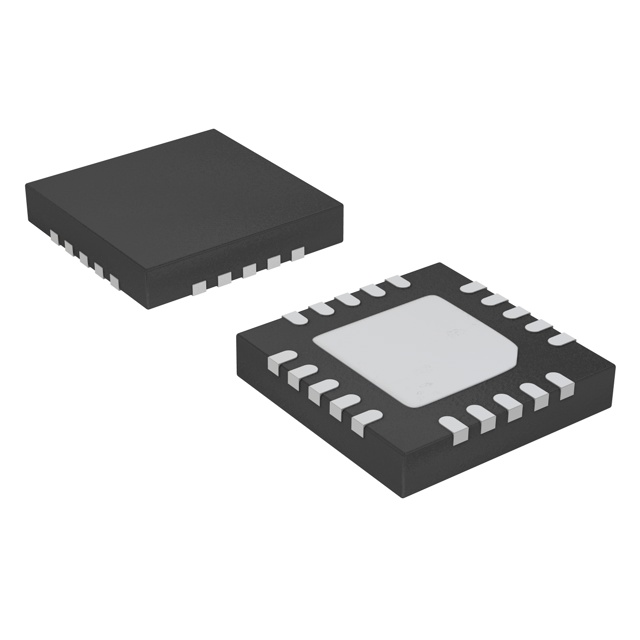
The Si5018 is part of the SiPHY family of CDR devices from Silicon Laboratories. The '-B-' designation indicates a specific silicon revision, while '-GM' denotes the 20-lead Quad Flat No-Lead (QFN) package. This device is engineered to replace traditional PLL-based CDRs that require complex external filtering.
Public confirmed substitute part numbers are not available in the provided documentation.
Self-calibration is initiated by forcing a high-to-low transition on the PWRDN/CAL pin while a valid reference clock is supplied. The pin must be held high for at least 1 µs before transitioning low.
The REXT pin is used to connect an external 10 kΩ (1%) resistor to ground. This resistor sets the internal bias currents, which reduces power consumption compared to implementations using internal resistors.
The LOL pin is driven high when the recovered clock frequency deviates from the reference clock by more than the specified threshold (e.g., 450–750 ppm). It indicates that the PLL has lost frequency lock with the incoming data stream.
 SI5018-B-GM
The activity of extra discounts on wholesale prices is in full swing…
Please fill in your contact information and we will send you the latest wholesale price list.