 ChipApex | Global Electronic Components Supplier
SEARCH
Search Product
Search Post
— IC芯片 | 连接器 | 传感器 | 被动器件 —
Search productSearch post
— IC芯片 | 连接器 | 传感器 | 被动器件 —
Consult the customer manager about the wholesale price.
consultation hotline:86-132-6715-2157
email:[email protected]
Contact the product manager for consultation. One-stop consultation is available.
Do you want a lower wholesale price? Please send us your inquiry and we will reply immediately.
The SI5338C-B-GMR is a programmable quad clock generator utilizing MultiSynth technology. It synthesizes four independent clocks with zero ppm accuracy via an I2C interface. The device supports flexible input references, including external crystals (8–30 MHz), CMOS (5–200 MHz), SSTL/HSTL (5–350 MHz), and differential inputs (5–710 MHz). Outputs support LVPECL/LVDS up to 710 MHz, HCSL up to 250 MHz, CMOS up to 200 MHz, and SSTL/HSTL up to 350 MHz. Key electrical parameters include a core supply voltage of 1.8 V, 2.5 V, or 3.3 V, typical operating current of 45 mA, and a typical phase jitter of 0.7 ps RMS.
Verify the specific ordering suffix against the manufacturer's official documentation to confirm package type, tape-and-reel specifications, and temperature range. Ensure compatibility with the I2C bus voltage levels (1.71 V to 3.63 V) required for the target system design.
Select this component when designing systems requiring low-jitter, multi-standard clock generation from a single IC. Consider the available input reference types and required output signal formats (LVDS vs. CMOS) to ensure the configuration meets the load requirements. Verify that the desired output frequencies fall within the supported ranges for the selected driver format.
The SI5338C-B-GMR belongs to the Si5338 family of I2C-programmable clock generators. This series is designed to replace multiple discrete crystal oscillators, reducing board space and power consumption while providing high-precision clock signals for high-speed digital interfaces.
Consult the manufacturer's datasheet for direct pin-compatible alternatives within the Si5338 family. Verify that any substitute part maintains the same output drive capabilities, jitter performance, and programming interface compatibility.
The device supports differential inputs up to 710 MHz, SSTL/HSTL inputs up to 350 MHz, and CMOS inputs up to 200 MHz.
Yes, it features an independent frequency increment/decrement capability that allows glitchless frequency adjustments in 1 ppm steps.
The typical phase jitter is 0.7 ps RMS, measured under standard test conditions with differential outputs.
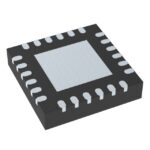 SI5338C-B-GMR
The activity of extra discounts on wholesale prices is in full swing…
Please fill in your contact information and we will send you the latest wholesale price list.





