 ChipApex | Global Electronic Components Supplier
SEARCH
Search Product
Search Post
— IC芯片 | 连接器 | 传感器 | 被动器件 —
Search productSearch post
— IC芯片 | 连接器 | 传感器 | 被动器件 —
Consult the customer manager about the wholesale price.
consultation hotline:86-132-6715-2157
email:[email protected]
Contact the product manager for consultation. One-stop consultation is available.
Do you want a lower wholesale price? Please send us your inquiry and we will reply immediately.
The SIG100 is a powerline transceiver that modulates UART and LIN protocol bytes over DC powerlines (DC-BUS), merging data and power transmission to eliminate separate control wires. It utilizes multiplex digital signaling technology to operate in noisy environments at bitrates up to 115.2 kbit/s. The device supports 251 selectable carrier frequencies between 5 MHz and 30 MHz, allowing multiple independent networks to coexist on a single powerline. It features backward compatibility with the SIG60 device and includes sleep modes for low power consumption. The component is housed in a QFN32 5x5 mm package.
Verify the specific ordering suffix against the manufacturer's current datasheet to ensure correct packaging and temperature grade. Confirm that the required external components, such as the 16MHz crystal and 10.7MHz bandpass filter, are sourced separately as they are not included within the IC package. Ensure the design accommodates the necessary passive components for the powerline coupling interface.
Select the SIG100 when wiring reduction is critical in automotive or industrial DC powerline applications. Choose this device if backward compatibility with existing SIG60 infrastructure is required. Verify that the application environment supports the required 3.3V logic levels and that the PCB layout can accommodate the QFN32 package and external filter requirements.
The SIG100 represents an advanced generation of powerline communication devices from Yamar Electronics, succeeding the widely used SIG60 model. It maintains backward compatibility while offering enhanced flexibility through a wider range of selectable carrier frequencies and configurable bitrates. This evolution allows for more complex network topologies and improved noise immunity in electrically noisy DC powerline environments.
The SIG100 is backward compatible with the SIG60 device when configured to specific carrier frequencies (5.5MHz, 6MHz, 6.5MHz, 10.5MHz, or 13MHz). A WRITE-REG command is required to enable this transparent communication mode.
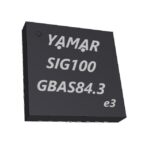 SIG100-IC
The activity of extra discounts on wholesale prices is in full swing…
Please fill in your contact information and we will send you the latest wholesale price list.





