ChipApex | Global Electronic Components Supplier
SEARCH
Search Product
Search Post
— IC芯片 | 连接器 | 传感器 | 被动器件 —
Search productSearch post
— IC芯片 | 连接器 | 传感器 | 被动器件 —
Consult the customer manager about the wholesale price.
consultation hotline:86-132-6715-2157
email:[email protected]
Contact the product manager for consultation. One-stop consultation is available.
Do you want a lower wholesale price? Please send us your inquiry and we will reply immediately.
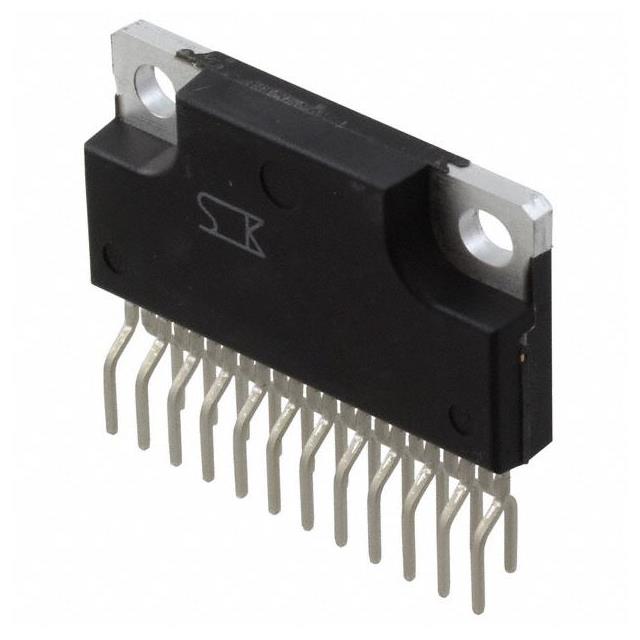
The SLA7070MR is a two-phase unipolar stepper motor driver from the Sanken Electric SLA707xM series. It integrates low-power CMOS logic with high-current, high-voltage power FET outputs in a Power Multi-Chip Module (PMCM). The device provides complete control and drive for two-phase unipolar stepper motors, featuring internal fixed off-time and pulse-width modulation (PWM) current control. It eliminates the need for phase-sequence tables or complex interfaces. The NMOS outputs are capable of sinking up to 1 A and withstanding 46 V in the off state. Key specifications include a maximum motor supply voltage (VM) of 44 V, a load supply voltage (Vs) range of 10 V to 44 V, and a logic supply voltage (Vcc) range of 3 V to 5.5 V.
Verify the specific suffix 'MR' matches the required package and temperature grade. Confirm that the 1 A sink current capability meets the motor coil requirements. Ensure the 46 V breakdown voltage aligns with the system's motor supply voltage. Check for any specific ordering codes related to tape and reel quantities if applicable.
Select this component when driving two-phase unipolar stepper motors requiring integrated logic and power stages. It is suitable for applications where microprocessor sequencing is undesirable or unavailable. Consider the 1 A output limit and 46 V voltage rating during design. Verify compatibility with TTL or LSTTL input levels using appropriate pull-up resistors if necessary.
The SLA7070MR belongs to the SLA707xM family of 2-Phase Unipolar Stepper Motor Drivers manufactured by Sanken Electric Co., Ltd. This series combines CMOS logic with power FETs to simplify stepper motor interface designs. The part is designed for office automation and printer applications, offering a compact solution for motor control without complex external circuitry.
Consult official Sanken Electric documentation for confirmed substitute part numbers within the SLA707xM series or equivalent product lines. Verify pinout compatibility and electrical specifications before substitution.
 SLA7070MR
The activity of extra discounts on wholesale prices is in full swing…
Please fill in your contact information and we will send you the latest wholesale price list.