 ChipApex | Global Electronic Components Supplier
SEARCH
Search Product
Search Post
— IC芯片 | 连接器 | 传感器 | 被动器件 —
Search productSearch post
— IC芯片 | 连接器 | 传感器 | 被动器件 —
Consult the customer manager about the wholesale price.
consultation hotline:86-132-6715-2157
email:[email protected]
Contact the product manager for consultation. One-stop consultation is available.
Do you want a lower wholesale price? Please send us your inquiry and we will reply immediately.
The SN65LV1212DBR is a deserializer component within the Texas Instruments SN65LV1021/SN65LV1212 chipset, designed for 10-bit LVDS serialization and deserialization. It operates with system clock frequencies ranging from 10 MHz to 40 MHz, supporting serial data rates between 120 Mbps and 480 Mbps. The device accepts a reference clock (REFCLK) and recovers embedded clock signals from incoming LVDS differential inputs (RI+ and RI-). It outputs parallel LVTTL data on pins ROUT0 through ROUT9 and provides a recovered clock output (RCLK). Key electrical characteristics include a supply voltage range of 3 V to 3.6 V, an operating temperature range of -40°C to 85°C, and typical power consumption under 350 mW at 40 MHz. The unit is housed in a 28-pin SSOP package.
Verify the specific ordering suffix 'DBR' corresponds to the tape-and-reel packaging format rather than tube packaging. Confirm the device status is appropriate for the design lifecycle, as datasheet records indicate this specific part number may be classified as NRND (Not Recommended for New Designs). Ensure compatibility with existing PCB footprints for the 28-pin SSOP package before finalizing procurement.
Select the SN65LV1212DBR only when paired with the corresponding SN65LV1021 serializer to form the complete 10:1 LVDS SerDes chipset. Verify that the system requires LVTTL parallel I/O levels and LVDS differential signaling. Consider the thermal dissipation requirements given the maximum package power dissipation rating. Ensure the application supports the specified 10 MHz to 40 MHz clock frequency range for proper PLL operation.
This component belongs to the SN65LV1021/SN65LV1212 family of 10-MHz to 40-MHz LVDS serializers and deserializers manufactured by Texas Instruments. It functions specifically as the receiver side of the chipset, complementing the SN65LV1021 transmitter. The series is engineered for high-speed data transmission across backplanes and cabling using Low-Voltage Differential Signaling standards.
Publicly confirmed substitute part numbers are not available in the provided documentation. Designers should consult Texas Instruments for current equivalent recommendations or alternative chipset solutions if this NRND part is discontinued.
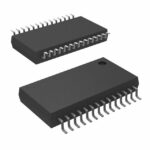 SN65LV1212DBR
The activity of extra discounts on wholesale prices is in full swing…
Please fill in your contact information and we will send you the latest wholesale price list.






