 ChipApex | Global Electronic Components Supplier
SEARCH
Search Product
Search Post
— IC芯片 | 连接器 | 传感器 | 被动器件 —
Search productSearch post
— IC芯片 | 连接器 | 传感器 | 被动器件 —
Consult the customer manager about the wholesale price.
consultation hotline:86-132-6715-2157
email:[email protected]
Contact the product manager for consultation. One-stop consultation is available.
Do you want a lower wholesale price? Please send us your inquiry and we will reply immediately.
The SN65LVDM22PW is a low-voltage differential signaling (LVDS) multiplexer manufactured by Texas Instruments. It features a single channel with a 2:2 configuration, supporting data rates up to 250 Mbps. The device operates on a supply voltage range of 3 V to 3.6 V and draws a typical supply current of 13 mA. It is housed in a 16-pin TSSOP package suitable for surface mount technology. The component functions as a signal buffer and multiplexer, providing a propagation delay of 4.0 ns and an input capacitance of 3 pF. It supports LVDS input and output signals within an operating temperature range of -40°C to +85°C.
Verify the specific ordering suffix to ensure the correct package variant and tape-and-reel or tube packaging options are selected. Confirm that the component meets RoHS compliance requirements for the intended market. Cross-reference the manufacturer part number with official distributor catalogs to validate authenticity and current production status before finalizing procurement orders.
Select this component when a single-channel LVDS multiplexer with 2:2 functionality is required. Ensure the system design accommodates the 3 V to 3.6 V supply voltage range and the 16-TSSOP package dimensions. Verify that the 250 Mbps data rate capability aligns with the application's bandwidth requirements and that the -40°C to +85°C operating temperature range is sufficient for the environmental conditions.
This part belongs to the SN65LVDS/DM22 series of low-voltage differential signaling components from Texas Instruments. The series includes variants such as the SN65LVDS22 and SN65LVDM22, which differ primarily in their internal multiplexer configurations. These devices are designed for high-speed data transmission applications requiring reliable signal integrity and low power consumption in compact surface-mount packages.
The SN65LVDS22PW is a related variant within the same family. Verify functional equivalence regarding the multiplexer configuration and pinout compatibility before substitution. Ensure that any replacement part maintains the same package type, voltage specifications, and performance characteristics.
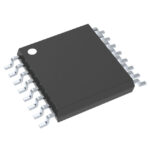 SN65LVDM22PW
The activity of extra discounts on wholesale prices is in full swing…
Please fill in your contact information and we will send you the latest wholesale price list.





