 ChipApex | Global Electronic Components Supplier
SEARCH
Search Product
Search Post
— IC芯片 | 连接器 | 传感器 | 被动器件 —
Search productSearch post
— IC芯片 | 连接器 | 传感器 | 被动器件 —
Consult the customer manager about the wholesale price.
consultation hotline:86-132-6715-2157
email:[email protected]
Contact the product manager for consultation. One-stop consultation is available.
Do you want a lower wholesale price? Please send us your inquiry and we will reply immediately.
The SN7414D is a hex Schmitt-trigger inverter manufactured by Texas Instruments, belonging to the standard 74 logic family. It features six independent inverters with Schmitt-trigger inputs within a single package. The device operates at a supply voltage of 5V and utilizes a 14-pin Small Outline Integrated Circuit (SOIC) surface-mount package. Key electrical characteristics include a maximum propagation delay of 22 nanoseconds at a load capacitance of 15 pF. Output drive capabilities are specified with a maximum low-level output current of 16 mA and a maximum high-level output current of -0.8 mA.
Verify that the specific order matches the SN7414D suffix, which denotes the SOIC-14 surface-mount package variant. Confirm the manufacturer is Texas Instruments to ensure compliance with the specified electrical parameters. Check for RoHS compliance status if required by project specifications. Ensure the operating temperature range aligns with the commercial grade limits defined in the datasheet.
Select this component when six Schmitt-trigger inverters are required in a surface-mount configuration. It serves as a direct alternative to through-hole DIP variants like the SN7414N when board space is limited. Consider the 16 mA low-level sink capability for driving moderate loads. Verify that the 22 ns propagation delay meets the system timing requirements.
This part belongs to the Texas Instruments 74 series of logic integrated circuits. It is functionally equivalent to other hex Schmitt-trigger inverters such as the SN74LS14D. The 'D' suffix specifically identifies the 14-pin SOIC package type. It is distinct from CMOS variants like the SN74HC14D, which operate over a wider voltage range.
The primary difference is the package type. The SN7414D uses a 14-pin SOIC surface-mount package, while the SN7414N uses a 14-pin PDIP through-hole package. Both share the same logical function and pinout.
Yes, it incorporates Schmitt-trigger inputs which provide hysteresis. This feature helps eliminate noise from slow-rising input signals.
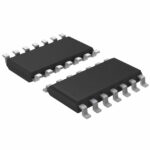 SN7414D
The activity of extra discounts on wholesale prices is in full swing…
Please fill in your contact information and we will send you the latest wholesale price list.





