 ChipApex | Global Electronic Components Supplier
SEARCH
Search Product
Search Post
— IC芯片 | 连接器 | 传感器 | 被动器件 —
Search productSearch post
— IC芯片 | 连接器 | 传感器 | 被动器件 —
Consult the customer manager about the wholesale price.
consultation hotline:86-132-6715-2157
email:[email protected]
Contact the product manager for consultation. One-stop consultation is available.
Do you want a lower wholesale price? Please send us your inquiry and we will reply immediately.
The SN74ACT16PWRQ1 is an automotive-grade hex Schmitt-trigger inverter featuring open-drain outputs and TTL-compatible inputs. It operates within a supply voltage range of 4.5V to 5.5V, providing continuous output drive of 24mA at 5V and supporting up to 75mA in short bursts. The device ensures fast operation with a maximum propagation delay of 7.2ns. Designed for robust performance, it withstands electrostatic discharge up to ±2000V via the human-body model. It functions reliably across an operating free-air temperature range from -40°C to +125°C.
Verify that the specific ordering suffix matches the required package type, as the SN74ACT16 family includes both TSSOP and WQFN options. Confirm the Q1 suffix aligns with automotive qualification requirements. Ensure the selected variant meets the necessary thermal and electrical specifications for the target application environment before finalizing procurement.
Select this component when designing circuits requiring noise immunity for digital signals, as the Schmitt-trigger architecture mitigates signal degradation. The open-drain output configuration is suitable for interfacing with different voltage domains or implementing bus structures. Consider the 24mA continuous drive capability when sizing loads, ensuring total power dissipation remains within absolute maximum ratings to prevent device damage.
This device belongs to the SN74ACT16-Q1 series, representing Texas Instruments' automotive-grade extension of the standard ACT logic family. It integrates six independent inverters into a single 14-pin package, specifically engineered for reliability in harsh automotive environments while maintaining compatibility with standard TTL logic levels.
SN74ACT16PW
Unused TTL-compatible CMOS inputs must not be left floating. They should be terminated directly to VCC or ground, or connected via a pull-up or pull-down resistor (typically 10kΩ) to ensure a valid logic state.
In the high logical state, the open-drain outputs enter a high-impedance state. They do not source current; the output voltage depends on external factors such as a pull-up resistor or connected load.
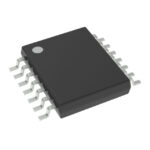 SN74ACT16PWRQ1
The activity of extra discounts on wholesale prices is in full swing…
Please fill in your contact information and we will send you the latest wholesale price list.





