 ChipApex | Global Electronic Components Supplier
SEARCH
Search Product
Search Post
— IC芯片 | 连接器 | 传感器 | 被动器件 —
Search productSearch post
— IC芯片 | 连接器 | 传感器 | 被动器件 —
Consult the customer manager about the wholesale price.
consultation hotline:86-132-6715-2157
email:[email protected]
Contact the product manager for consultation. One-stop consultation is available.
Do you want a lower wholesale price? Please send us your inquiry and we will reply immediately.
The SN74ACT573NS is an octal D-type transparent latch manufactured by Texas Instruments, featuring three-state outputs. It operates within a supply voltage range of 4.5 V to 5.5 V and utilizes a PDIP-20 package for through-hole mounting. The device exhibits a propagation delay of 10.5 ns and a static current of 4 uA. Output drive capabilities include a low-level output current of 32 mA and a high-level output current of -24 mA. It functions reliably across an operating temperature range from -40 °C to +85 °C.
Verify the specific suffix 'N' corresponds to the PDIP-20 through-hole package configuration required for your design. Confirm RoHS compliance status and lead times directly with authorized distributors or Texas Instruments prior to ordering. Ensure the procurement documentation matches the exact part number to avoid receiving surface-mount variants such as the NSR.
Select this component when a through-hole octal latch with three-state outputs is required for 5V logic systems. It is suitable for applications needing TTL input compatibility and moderate speed performance. Consider alternative packages like SOIC or SSOP if space constraints necessitate surface-mount technology instead of through-hole mounting.
This device belongs to the Texas Instruments 74ACT logic family, which combines the speed of AC logic with CMOS power consumption. The SN74ACT573 series is widely used in digital systems requiring data storage and bus interfacing. It serves as a standard solution for managing parallel data flow in microprocessor-based designs and peripheral interfaces.
The SN74ACT573NSR offers identical electrical functionality but utilizes an SOIC-20 surface-mount package. Other compatible parts within the same family may include different packaging options or slight variations in pinout configurations. Verify mechanical fit and soldering requirements before substituting.
The Output Enable (OE) pin controls the state of the outputs. When OE is low, the outputs are active and follow the latch data. When OE is high, the outputs enter a high-impedance state, effectively disconnecting them from the circuit.
The Latch Enable (LE) pin determines transparency. When LE is high, the outputs Q follow the inputs D. When LE transitions low, the value present at the inputs at that moment is latched and retained at the outputs until LE goes high again.
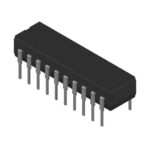 SN74ACT573NS
The activity of extra discounts on wholesale prices is in full swing…
Please fill in your contact information and we will send you the latest wholesale price list.






