 ChipApex | Global Electronic Components Supplier
SEARCH
Search Product
Search Post
— IC芯片 | 连接器 | 传感器 | 被动器件 —
Search productSearch post
— IC芯片 | 连接器 | 传感器 | 被动器件 —
Consult the customer manager about the wholesale price.
consultation hotline:86-132-6715-2157
email:[email protected]
Contact the product manager for consultation. One-stop consultation is available.
Do you want a lower wholesale price? Please send us your inquiry and we will reply immediately.
The SN74AHC05N is a hex inverter with open-drain outputs manufactured by Texas Instruments. It operates within a supply voltage range of 2 V to 5.5 V and supports an operating temperature range from -40°C to +85°C. The device contains six independent inverters performing the Boolean function Y = A bar. It features latch-up performance exceeding 250 mA per JESD 17 and ESD protection exceeding 2000-V human-body model, 200-V machine model, and 1000-V charged-device model. The package type is PDIP-14.
Verify that the specific part number matches the required PDIP-14 package configuration. Confirm the operating temperature range meets the application's environmental requirements of -40°C to +85°C. Ensure that the design includes appropriate external pullup resistors, as the open-drain outputs require them to perform correctly. Check RoHS compliance status if required by the manufacturing process.
Select this component when six independent inverters with open-drain outputs are needed within a single package. It is suitable for applications requiring wired-OR or wired-AND configurations. Consider the 2 V to 5.5 V supply voltage range and the -40°C to +85°C operating temperature range. Verify that the PDIP-14 through-hole package fits the board layout constraints.
The SN74AHC05N belongs to the SN74AHC05 family of hex inverters with open-drain outputs. It is part of Texas Instruments' AHC logic series, designed for low power consumption and high-speed operation. The N suffix indicates a plastic dual-in-line package (PDIP) with 14 pins. This family provides compatibility with standard CMOS logic levels while offering enhanced static stability and ESD protection.
SN74AHC05PW
The SN74AHC05N features open-drain outputs, which means they can only sink current to ground. To drive the output high, an external pullup resistor must be connected between the output pin and the supply voltage (VCC).
Each of the six inverters in the SN74AHC05N performs the Boolean NOT function, where the output Y is the inverse of the input A (Y = A bar).
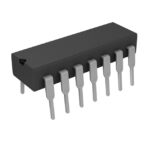 SN74AHC05N
The activity of extra discounts on wholesale prices is in full swing…
Please fill in your contact information and we will send you the latest wholesale price list.





