 ChipApex | Global Electronic Components Supplier
SEARCH
Search Product
Search Post
— IC芯片 | 连接器 | 传感器 | 被动器件 —
Search productSearch post
— IC芯片 | 连接器 | 传感器 | 被动器件 —
Consult the customer manager about the wholesale price.
consultation hotline:86-132-6715-2157
email:[email protected]
Contact the product manager for consultation. One-stop consultation is available.
Do you want a lower wholesale price? Please send us your inquiry and we will reply immediately.
The SN74AHC123ADBR is a dual retriggerable monostable multivibrator from the Texas Instruments AHC series, housed in a 16-pin SSOP package. It operates within a supply voltage range of 2V to 5.5V and supports an operating temperature range of -40°C to 85°C. The device features Schmitt-trigger circuitry on inputs A, B, and CLR to accommodate slow input transition rates. It provides edge triggering from active-high or active-low gated logic inputs and includes glitch-free power-up reset on outputs.
Verify the specific ordering suffix 'DBR' corresponds to the SSOP-16 package with tape-and-reel carrier configuration. Confirm the RoHS compliance status and lead finish (NIPDAU) match project requirements. Ensure the operating temperature range (-40°C to 85°C) aligns with environmental specifications. Cross-reference the manufacturer part number against current availability lists as product statuses may change.
Select this component when dual independent monostable multivibrators are required in a compact surface-mount form factor. The AHC series offers high-speed performance suitable for modern digital systems. Verify that the external timing components (resistor and capacitor) can provide the desired pulse duration based on the device's switching characteristics. Consider the SSOP package dimensions if board space is constrained.
This device belongs to the SNx4AHC123A family of dual retriggerable monostable multivibrators. It shares functional compatibility with other variants in the series, such as those in SOIC, TSSOP, and TVSOP packages. The 'AHC' designation indicates advanced high-speed CMOS technology, offering lower power consumption compared to older logic families while maintaining fast propagation delays.
SN74AHC123APWR (TSSOP-16)
The A, B, and CLR inputs feature Schmitt-trigger circuitry, which provides sufficient hysteresis to handle slow input transition rates without causing jitter at the outputs.
During power-up, the Q outputs are in the low state, and the Q outputs are in the high state. This reset process is glitch-free and does not require applying a separate reset pulse.
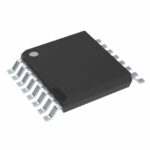 SN74AHC123ADBR
The activity of extra discounts on wholesale prices is in full swing…
Please fill in your contact information and we will send you the latest wholesale price list.







