 ChipApex | Global Electronic Components Supplier
SEARCH
Search Product
Search Post
— IC芯片 | 连接器 | 传感器 | 被动器件 —
Search productSearch post
— IC芯片 | 连接器 | 传感器 | 被动器件 —
Consult the customer manager about the wholesale price.
consultation hotline:86-132-6715-2157
email:[email protected]
Contact the product manager for consultation. One-stop consultation is available.
Do you want a lower wholesale price? Please send us your inquiry and we will reply immediately.
The SN74AHCT132PWRE4 is a quadruple positive-NAND gate with Schmitt-trigger inputs manufactured by Texas Instruments. It operates within a supply voltage range of 4.5 V to 5.5 V and features a TSSOP-14 package. The device provides four independent NAND gates, each equipped with Schmitt-trigger functionality for noise immunity. Key electrical parameters include a maximum propagation delay of 10 ns at 5 V with 50 pF load capacitance, and output drive currents of 8 mA for both high and low states. It supports an operating temperature range from -40°C to +85°C.
Verify the specific suffix 'E4' indicates lead-free composition and RoHS compliance as per Texas Instruments standards. Confirm the package type matches the required TSSOP-14 footprint for PCB layout compatibility. Ensure the voltage domain aligns with 5 V systems, as this HCT variant requires a minimum supply of 4.5 V. Cross-reference the manufacturer part number against official distributors to avoid counterfeit components.
Select this component when Schmitt-trigger action is required on NAND gates within a 5 V logic system. It serves as a direct replacement for other SN74HCT132 variants with compatible pinouts. Consider the TSSOP-14 package constraints regarding thermal dissipation and board space. Verify that the input voltage levels match the source logic family specifications before integration into the design.
This part belongs to the SN74AHCT series, which combines the high-speed CMOS technology of the AHC series with TTL-compatible input levels. The '132' designation specifically identifies the quad NAND gate configuration with Schmitt triggers. The 'PWRE4' suffix denotes the TSSOP-14 package, reel packaging, and environmental compliance attributes defined by Texas Instruments.
SN74AHCT132PWR is a functionally equivalent alternative without the E4 suffix. SN74HCT132PW offers similar performance but may differ in switching speed characteristics. SN74LVC1G132 provides a single-gate solution in a smaller package. Verify pinout compatibility and voltage tolerance before substituting.
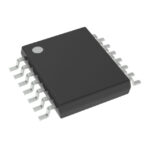 SN74AHCT132PWRE4
The activity of extra discounts on wholesale prices is in full swing…
Please fill in your contact information and we will send you the latest wholesale price list.





