 ChipApex | Global Electronic Components Supplier
SEARCH
Search Product
Search Post
— IC芯片 | 连接器 | 传感器 | 被动器件 —
Search productSearch post
— IC芯片 | 连接器 | 传感器 | 被动器件 —
Consult the customer manager about the wholesale price.
consultation hotline:86-132-6715-2157
email:[email protected]
Contact the product manager for consultation. One-stop consultation is available.
Do you want a lower wholesale price? Please send us your inquiry and we will reply immediately.
The SN74ALB16244DL is a 16-bit buffer and line driver with 3-state outputs manufactured by Texas Instruments. It utilizes Advanced Low-Voltage BiCMOS (ALB) technology designed for 3.3-V operation. The device features Schottky diodes on all inputs to eliminate overshoot and undershoot, and distributed VCC and GND pins to minimize high-speed switching noise. It operates within a supply voltage range of 3 V to 3.6 V and an operating temperature range of -40°C to 85°C. Key electrical characteristics include a typical propagation delay of 1.3 ns at 3.3 V, symmetrical active-low output-enable inputs, and a maximum high-level output current of -25 mA.
Verify the specific ordering suffix 'DL' corresponds to the SSOP-48 tube package configuration. Confirm that the component status aligns with project requirements, as datasheet addendums may indicate production lifecycle changes. Ensure input voltage ratings are respected to maintain device reliability under absolute maximum conditions.
Select this component when designing systems requiring 3.3-V logic levels with minimal propagation delay. The ALB technology offers superior performance compared to standard CMOS alternatives. Verify that the SSOP-48 package dimensions fit the available PCB real estate. Consider the thermal impedance specifications if multiple devices operate simultaneously in confined spaces.
This device belongs to Texas Instruments’ Widebus family, which provides industry-standard pinouts for 16-bit wide data buses. The SN74ALB16244 series is engineered to replace conventional drivers in applications demanding faster switching speeds. It supports configurations as four 4-bit buffers, two 8-bit buffers, or a single 16-bit buffer depending on system architecture needs.
SN74ALB16244DGGR
The device incorporates Schottky diodes on all inputs specifically designed to eliminate overshoot and undershoot, ensuring stable signal transitions during high-speed operation.
The distributed power and ground pins are strategically placed to minimize high-speed switching noise generated during simultaneous output state changes.
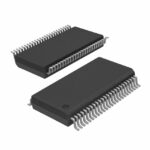 SN74ALB16244DL
The activity of extra discounts on wholesale prices is in full swing…
Please fill in your contact information and we will send you the latest wholesale price list.





