 ChipApex | Global Electronic Components Supplier
SEARCH
Search Product
Search Post
— IC芯片 | 连接器 | 传感器 | 被动器件 —
Search productSearch post
— IC芯片 | 连接器 | 传感器 | 被动器件 —
Consult the customer manager about the wholesale price.
consultation hotline:86-132-6715-2157
email:[email protected]
Contact the product manager for consultation. One-stop consultation is available.
Do you want a lower wholesale price? Please send us your inquiry and we will reply immediately.
The SN74ALS04BNS is a hex inverter integrated circuit manufactured by Texas Instruments, belonging to the Advanced Low-Power Schottky (ALS) logic family. It features six independent inverters within a single package. The device operates on a bipolar logic type and is housed in a 14-pin SOIC surface-mount package. It supports a supply voltage range of 4.5 V to 5.5 V. Key electrical characteristics include a maximum propagation delay of 11 ns at 5 V with a 50 pF load. The output configuration provides a low-level output current of 8 mA and a high-level output current of -400 uA. The component is rated for an operating temperature range from 0°C to +70°C.
Verify the specific suffix 'N' against official Texas Instruments documentation to confirm pinout and package dimensions, as variations exist within the ALS series. Ensure compatibility with 4.5V to 5.5V supply rails. Confirm RoHS compliance status through the manufacturer's latest datasheet or environmental information documents before integration into designs requiring specific regulatory standards.
Select this component when designing systems requiring the balance of speed and power efficiency offered by the ALS family. It serves as a direct functional replacement for older 74LS04 devices where lower power dissipation is required without significant speed penalty. Verify that the 14-SOIC footprint matches the PCB layout constraints and that the 8 mA sink current meets the fan-out requirements of the connected logic gates.
This part belongs to the Texas Instruments SN74ALS04 series, which includes variants such as the SN74ALS04BDR and SN74ALS04BNSR. These components are widely used in general-purpose digital electronics. The ALS series represents an evolution over standard LS logic, offering improved performance metrics while maintaining pin compatibility with legacy designs.
SN74ALS04BNSR is a parameter-equivalent alternative available from Texas Instruments. DM74ALS04BM is listed as a discontinued option with similar specifications but requires verification of active status and sourcing availability.
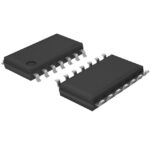 SN74ALS04BNS
The activity of extra discounts on wholesale prices is in full swing…
Please fill in your contact information and we will send you the latest wholesale price list.




