 ChipApex | Global Electronic Components Supplier
SEARCH
Search Product
Search Post
— IC芯片 | 连接器 | 传感器 | 被动器件 —
Search productSearch post
— IC芯片 | 连接器 | 传感器 | 被动器件 —
Consult the customer manager about the wholesale price.
consultation hotline:86-132-6715-2157
email:[email protected]
Contact the product manager for consultation. One-stop consultation is available.
Do you want a lower wholesale price? Please send us your inquiry and we will reply immediately.
The SN74ALS05ANS is a hex inverter integrated circuit manufactured by Texas Instruments, belonging to the Advanced Low-Power Schottky (ALS) logic family. It features six independent inverters with open-collector outputs, designed for operation within a supply voltage range of 4.5 V to 5.5 V. The device utilizes a 14-pin Small Outline Integrated Circuit (SOIC) package suitable for surface-mount applications. Key electrical characteristics include a propagation delay of approximately 12 ns at 5 V and a low-level output current capability of 8 mA. It operates reliably across a temperature range of 0°C to +70°C.
Verify the specific suffix 'ANS' corresponds to the SOIC-14 package variant when sourcing. Confirm RoHS compliance status through official manufacturer documentation prior to integration. Ensure supply chain partners provide valid certificates of conformity. Cross-reference datasheet revisions to guarantee parameter consistency with design requirements.
Select this component for designs requiring multiple inverted signals with open-collector flexibility. The ALS series offers a balance of speed and power efficiency compared to standard TTL. Verify that load conditions do not exceed the specified 8 mA sink current limit. Consider thermal dissipation requirements based on the SOIC package thermal resistance characteristics.
This part belongs to the Texas Instruments SN74ALS series, which represents an evolution of the classic 7400-series logic families. The ALS technology improves upon earlier LS variants by offering faster switching speeds while maintaining lower power dissipation. This specific model focuses on inversion functions with open-collector outputs, distinguishing it from push-pull output variants in the same family.
Compatible substitutes include other SN74ALS05 variants with different packaging options such as SN74ALS05N (PDIP). Verify pin compatibility and electrical specifications before substitution. Alternative manufacturers may offer equivalent parts under different naming conventions, but functional equivalence must be confirmed against the official datasheet parameters.
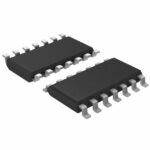 SN74ALS05ANS
The activity of extra discounts on wholesale prices is in full swing…
Please fill in your contact information and we will send you the latest wholesale price list.





