 ChipApex | Global Electronic Components Supplier
SEARCH
Search Product
Search Post
— IC芯片 | 连接器 | 传感器 | 被动器件 —
Search productSearch post
— IC芯片 | 连接器 | 传感器 | 被动器件 —
Consult the customer manager about the wholesale price.
consultation hotline:86-132-6715-2157
email:[email protected]
Contact the product manager for consultation. One-stop consultation is available.
Do you want a lower wholesale price? Please send us your inquiry and we will reply immediately.
The SN74ALS1005N is a hex inverting buffer manufactured by Texas Instruments, belonging to the Advanced Low-power Schottky (ALS) logic family. It features six independent inverters with open-collector outputs, designed for operation within a supply voltage range of 4.5 V to 5.5 V. The device utilizes bipolar technology and is housed in a standard 14-pin Dual In-line Package (PDIP). This component serves as a digital logic interface, providing signal inversion and buffering capabilities suitable for various electronic circuit applications.
Verify the specific ordering suffix to confirm package type and tape/reel specifications, as these details define the physical form factor and handling requirements. Ensure the selected variant matches the required industrial or commercial temperature range for the intended application environment. Cross-reference the manufacturer's current datasheet to confirm active status and any recent design changes before finalizing procurement decisions.
Select this component when a hex inverter with open-collector outputs is required within the ALS logic family. The choice depends on the need for bipolar performance characteristics and the specific voltage operating range of 4.5 V to 5.5 V. Consider the PDIP-14 package constraints for through-hole mounting if surface mount alternatives are not feasible for the design.
This part belongs to the SN74ALS series, which represents an evolution in low-power Schottky logic technology. The SN74ALS1005N specifically addresses the need for multiple inverted signals in a single integrated circuit. It complements other gates in the family, such as AND or NAND functions, by providing necessary signal conditioning and inversion stages in complex digital designs.
Direct pin-compatible replacements within the same ALS family should be verified against official substitution lists. Ensure that any alternative part maintains the open-collector output characteristic and compatible voltage ranges. Consult Texas Instruments documentation for validated cross-references to avoid functional mismatches.
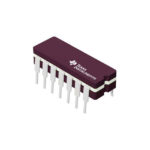 SN74ALS1005N
The activity of extra discounts on wholesale prices is in full swing…
Please fill in your contact information and we will send you the latest wholesale price list.





