 ChipApex | Global Electronic Components Supplier

SEARCH
Search Product
Search Post
— IC芯片 | 连接器 | 传感器 | 被动器件 —
Search productSearch post
— IC芯片 | 连接器 | 传感器 | 被动器件 —
Consult the customer manager about the wholesale price.
consultation hotline:86-132-6715-2157
email:[email protected]
Contact the product manager for consultation. One-stop consultation is available.
Do you want a lower wholesale price? Please send us your inquiry and we will reply immediately.
The SN74ALS258AN is a quad 2-input multiplexer with 3-state outputs manufactured by Texas Instruments. It operates within a supply voltage range of 4.5 V to 5.5 V and supports an operating temperature range of 0°C to 70°C. The device features low-level input current of -0.1 mA and high-level output current capability of -2.6 mA. Propagation delays from data inputs (A or B) to output (Y) range from 2 ns to 9 ns, while select line (A/B) delays range from 5 ns to 25 ns. Enable/disable times vary between 2 ns and 37 ns depending on the transition direction.
Verify the specific ordering suffix 'AN' corresponds to the standard plastic DIP package configuration. Confirm the manufacturer identification as Texas Instruments through official documentation. Ensure the component meets the specified commercial temperature range requirements for your application environment before integration.
Select this component for applications requiring quad 2-to-1 multiplexing with tri-state output control. Consider the ALS technology for balanced speed and power consumption compared to standard TTL. Verify that the required operating temperature range aligns with the commercial specification limits defined in the datasheet.
This part belongs to the SN74ALS series of advanced low-power Schottky logic devices. It functions as a data selector/multiplexer designed for bus-organized systems. The device is distinct from the SN54 variant which supports military temperature ranges, and differs from the AS series which offers higher drive currents and faster switching speeds.
SN74ALS257A is functionally similar but lacks the 3-state outputs found in the SN74ALS258A. SN74AS258A provides enhanced performance characteristics including higher output current and reduced propagation delays while maintaining the same logical functionality and pinout compatibility.
When the output-enable (OE) input is at a high logic level, the three-state outputs do not load the data lines, effectively isolating them.
The A/B input acts as the select line to choose between the two data sources (A or B) for each channel. The A and B inputs are the actual data lines being multiplexed.
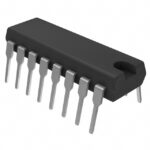 SN74ALS258AN

The activity of extra discounts on wholesale prices is in full swing…
Please fill in your contact information and we will send you the latest wholesale price list.






