 ChipApex | Global Electronic Components Supplier
SEARCH
Search Product
Search Post
— IC芯片 | 连接器 | 传感器 | 被动器件 —
Search productSearch post
— IC芯片 | 连接器 | 传感器 | 被动器件 —
Consult the customer manager about the wholesale price.
consultation hotline:86-132-6715-2157
email:[email protected]
Contact the product manager for consultation. One-stop consultation is available.
Do you want a lower wholesale price? Please send us your inquiry and we will reply immediately.
The SN74ALVC162831DBBR is a 1-bit to 4-bit address register/driver with 3-state outputs, operating from 1.65 V to 3.6 V. It features a maximum propagation delay of 4.3 ns at 3.3 V and ±12-mA output drive capability. The device includes equivalent 26-Ω series resistors in the output ports to reduce overshoot and undershoot without requiring external components. It provides latch-up performance exceeding 250 mA per JESD 17 and ESD protection exceeding 2000-V human-body model standards.
Verify the specific package marking ALVC162831 and orderable part number SN74ALVC162831DBBR against the manufacturer's current production status. Confirm that the DBB TVSOP package dimensions and tape-and-reel specifications align with the design requirements. Ensure compliance with RoHS and lead-free material declarations as specified in the ordering information section of the datasheet.
Select this component when designing systems requiring a 1-to-4 bit address expansion with integrated damping resistors. The wide voltage range supports low-power operation down to 1.65 V. Consider the dual output-enable structure if independent control of output groups is necessary for the specific circuit topology.
This device belongs to the Texas Instruments Widebus family of logic products. It is designed for high-speed digital applications where signal integrity is critical due to the built-in series resistance. The component serves as a bridge between standard logic levels and memory interfaces requiring buffered address lines.
Consult the manufacturer's official replacement guide for direct substitutes. Verify pin compatibility and electrical characteristics before substituting with other members of the ALVC logic family.
The device operates in buffer mode when the SEL input is logic high, allowing outputs to follow inputs. It switches to register mode when SEL is logic low, storing data on the positive transition of the CLK input.
The outputs include equivalent 26-Ω series resistors designed to reduce overshoot and undershoot, eliminating the need for external resistors in most applications.
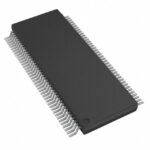 SN74ALVC162831DBBR
The activity of extra discounts on wholesale prices is in full swing…
Please fill in your contact information and we will send you the latest wholesale price list.





