 ChipApex | Global Electronic Components Supplier

SEARCH
Search Product
Search Post
— IC芯片 | 连接器 | 传感器 | 被动器件 —
Search productSearch post
— IC芯片 | 连接器 | 传感器 | 被动器件 —
Consult the customer manager about the wholesale price.
consultation hotline:86-132-6715-2157
email:[email protected]
Contact the product manager for consultation. One-stop consultation is available.
Do you want a lower wholesale price? Please send us your inquiry and we will reply immediately.
SN74ALVCH16270DGGR is listed in the Universal Bus Functions range at ChipApex. The manufacturer field lists Texas Instruments. Its product description is IC RGSTRD BUS EXCHANGER 56TSSOP. Review the specifications below when checking this part for your BOM.
The SN74ALVCH16270DGGR is a 12-bit to 24-bit registered bus exchanger with 3-state outputs, designed for 1.65-V to 3.6-V VCC operation. It provides synchronous data exchange between two ports, storing data in internal registers on the low-to-high transition of the clock input when appropriate CLKEN inputs are low. The device features active bus-hold circuitry on data inputs and ESD protection exceeding 2000 V per MIL-STD-883. It operates from -40 °C to 85 °C.
Verify the specific package type matches the design requirements, as the SN74ALVCH16270 family includes both SSOP (DL) and TSSOP (DGG) options. Confirm that the ordering suffix corresponds to the desired packaging format, such as tube or tape-and-reel, before finalizing procurement. Ensure compatibility with the intended operating voltage range of 1.65 V to 3.6 V.
Select this component for applications requiring registered bus exchanging capabilities within the ALVCH logic family. Consider the propagation delay characteristics and power dissipation capacitance values when designing for high-frequency operations up to 150 MHz. Evaluate the thermal impedance of the DGG package if heat dissipation is a critical factor in the system design.
This device belongs to the Texas Instruments Widebus family and utilizes the EPIC submicron process. It is characterized for operation across an extended temperature range. The SN74ALVCH16270 serves as a bridge between different bus widths, facilitating efficient data transfer in complex digital systems.
SN74ALVCH16270DL
Active bus-hold circuitry is provided to hold unused or floating data inputs at a valid logic level, eliminating the need for external pullup or pulldown resistors.
Data flow is controlled by the active-low output enables (OEA, OEB). The control terminals are registered to synchronize bus-direction changes with the clock signal.
Explore related parts through Logic, Integrated Circuits (ICs), all product categories, ChipApex homepage.
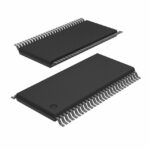 SN74ALVCH16270DGGR

The activity of extra discounts on wholesale prices is in full swing…
Please fill in your contact information and we will send you the latest wholesale price list.





