 ChipApex | Global Electronic Components Supplier
SEARCH
Search Product
Search Post
— IC芯片 | 连接器 | 传感器 | 被动器件 —
Search productSearch post
— IC芯片 | 连接器 | 传感器 | 被动器件 —
Consult the customer manager about the wholesale price.
consultation hotline:86-132-6715-2157
email:[email protected]
Contact the product manager for consultation. One-stop consultation is available.
Do you want a lower wholesale price? Please send us your inquiry and we will reply immediately.
The SN74ALVCH16334DLR is a 16-bit universal bus driver with 3-state outputs manufactured by Texas Instruments. It operates within a supply voltage range of 1.65 V to 3.6 V and utilizes the EPIC submicron process. The device features active bus-hold circuitry on data inputs, eliminating the need for external pullup or pulldown resistors. It is characterized for operation from -40 °C to 85 °C and is designed to comply with JEDEC 168-Pin and 200-Pin SDRAM buffered DIMM specifications.
Verify the specific package variant against the datasheet, as the DL suffix denotes SSOP-48. Confirm RoHS compliance status and Moisture Sensitivity Level (MSL) ratings prior to ordering. Ensure design compatibility with the specified 1.65-V to 3.6-V operating voltage range and industrial temperature limits.
Select this component for applications requiring 16-bit data latching and bus driving within the ALVCH family voltage range. Consider the SSOP-48 package constraints for PCB layout. Verify that the required clock frequency and propagation delay characteristics meet system timing requirements under the intended supply voltage conditions.
This device belongs to the Texas Instruments Widebus family and is built using the Enhanced-Performance Implanted CMOS (EPIC) submicron process. It offers ESD protection exceeding 2000 V per MIL-STD-883 and latch-up performance exceeding 250 mA per JESD 17, ensuring robustness in high-density digital environments.
Direct substitutes include SN74ALVCH16334DGGRE4, SN74ALVCH16334DGGRG4, SN74ALVCH16334DGVRE4, and SN74ALVCH16334DGVRG4. These alternatives share identical electrical characteristics but differ in package type (TSSOP or TVSOP) rather than function.
Active bus-hold circuitry is provided on the data inputs to hold unused or floating inputs at a valid logic level, eliminating the need for external pullup or pulldown resistors.
To ensure the high-impedance state during power up or power down, the OE input should be tied to VCC through a pullup resistor, with the minimum value determined by the current-sinking capability of the driver.
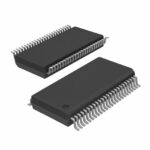 SN74ALVCH16334DLR
The activity of extra discounts on wholesale prices is in full swing…
Please fill in your contact information and we will send you the latest wholesale price list.





