 ChipApex | Global Electronic Components Supplier
SEARCH
Search Product
Search Post
— IC芯片 | 连接器 | 传感器 | 被动器件 —
Search productSearch post
— IC芯片 | 连接器 | 传感器 | 被动器件 —
Consult the customer manager about the wholesale price.
consultation hotline:86-132-6715-2157
email:[email protected]
Contact the product manager for consultation. One-stop consultation is available.
Do you want a lower wholesale price? Please send us your inquiry and we will reply immediately.
The SN74ALVCH16835DGGR is a 16-bit buffer and line driver with 3-state outputs manufactured by Texas Instruments. It operates within a voltage range of 2.7 V to 3.6 V, utilizing advanced low-voltage CMOS technology. The device features controlled slew rates to minimize signal reflections and supports parallel hold modes for data retention during bus release. It includes ESD protection exceeding 2000 V per the human body model, ensuring robust performance in high-speed digital applications.
Verify the package type matches the TSSOP-56 specification when sourcing. Confirm the suffix DGGR indicates tape and reel packaging. Ensure the operating temperature range aligns with industrial requirements. Cross-reference the manufacturer's latest datasheet for any pinout revisions or electrical characteristic updates before finalizing procurement specifications.
Select this component when interfacing between 3.3 V logic families requiring high-speed buffering. The controlled slew rate makes it suitable for applications where signal integrity is critical. Verify that the supply voltage remains within the 2.7 V to 3.6 V window. Consider the 56-pin TSSOP package constraints for PCB layout and thermal management during system design.
This part belongs to the SN74ALVCH series of low-voltage CMOS logic devices. It provides 16-bit non-inverting buffer functionality with 3-state outputs. The ALVCH family is designed for high-speed applications requiring low power dissipation and compatibility with various logic standards. The DGGR variant specifically denotes the TSSOP package with tape and reel delivery.
Check for direct equivalents such as the SN74ALVCH16835DGR from the same manufacturer. Verify pin compatibility and electrical characteristics against alternative suppliers' offerings. Ensure substitute parts maintain the same voltage range and package dimensions for seamless integration without redesign.
The parallel hold mode retains the last valid data state at the outputs even when the device is disabled, preventing undefined states on the bus.
Controlled slew rates reduce signal reflections and electromagnetic interference (EMI) by slowing down the transition edges of the output signals.
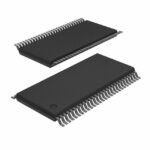 SN74ALVCH16835DGGR
The activity of extra discounts on wholesale prices is in full swing…
Please fill in your contact information and we will send you the latest wholesale price list.





