 ChipApex | Global Electronic Components Supplier
SEARCH
Search Product
Search Post
— IC芯片 | 连接器 | 传感器 | 被动器件 —
Search productSearch post
— IC芯片 | 连接器 | 传感器 | 被动器件 —
Consult the customer manager about the wholesale price.
consultation hotline:86-132-6715-2157
email:[email protected]
Contact the product manager for consultation. One-stop consultation is available.
Do you want a lower wholesale price? Please send us your inquiry and we will reply immediately.
The SN74ALVCH16901DGGR is an 18-bit (dual-octal) noninverting registered transceiver designed for 1.65-V to 3.6-V VCC operation. It features integrated parity generators and checkers for error detection in universal bus applications. The device utilizes a TSSOP-64 package and operates within a temperature range of -40°C to +85°C. It supports bidirectional data communication with registered outputs, ensuring stable signal integrity across high-speed digital interfaces.
Verify the complete part number including the DGGR suffix to confirm the TSSOP-64 package and reel packaging configuration. Ensure compatibility with the target voltage domain between 1.65 V and 3.6 V. Confirm that the application requires registered outputs and integrated parity functions rather than simple unregistered buffering. Check for specific revision levels if strict timing parameters are critical for the design.
Select this component when an 18-bit width is required alongside hardware-based parity calculation. It is suitable for designs needing registered outputs to manage skew in wide buses. Consider the TSSOP-64 footprint constraints during PCB layout. This device is appropriate for systems operating within the specified low-voltage range where power consumption and signal integrity are prioritized over higher voltage tolerance.
This part belongs to the Texas Instruments SN74ALVCH16 series, which focuses on low-voltage CMOS technology. The ALVCH family provides performance improvements over standard LVCH devices while maintaining compatibility. The SN74ALVCH16901 specifically addresses the need for parity handling in wide bus architectures, distinguishing it from standard transceivers like the SN74ALVCH16245 which lack integrated error checking logic.
Direct replacements must support 18-bit width and integrated parity functions. The SN74ALVCH16901DGG is the same device in a leaded TSSOP package without the reel suffix. Verify pinout compatibility if substituting with other 18-bit registered transceivers, as parity pin assignments may vary across different manufacturers or series.
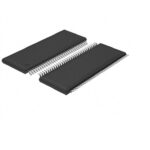 SN74ALVCH16901DGGR
The activity of extra discounts on wholesale prices is in full swing…
Please fill in your contact information and we will send you the latest wholesale price list.






