 ChipApex | Global Electronic Components Supplier
SEARCH
Search Product
Search Post
— IC芯片 | 连接器 | 传感器 | 被动器件 —
Search productSearch post
— IC芯片 | 连接器 | 传感器 | 被动器件 —
Consult the customer manager about the wholesale price.
consultation hotline:86-132-6715-2157
email:[email protected]
Contact the product manager for consultation. One-stop consultation is available.
Do you want a lower wholesale price? Please send us your inquiry and we will reply immediately.
The SN74ALVCHG162280GR is a 16-bit to 32-bit registered bus exchanger with byte masks and 3-state outputs. It operates at a supply voltage of 3 V to 3.6 V, with an operating temperature range of 0 °C to 70 °C. The device features a maximum clock frequency of 160 MHz. Propagation delays (t_pd) from CLK to B or D ports range from 1.5 ns to 7.4 ns. Output enable times (t_en) range from 1.5 ns to 9.5 ns, while disable times (t_dis) range from 1.5 ns to 7.6 ns. High-level output current is 8 mA for A-to-B direction and 6 mA for B-to-A direction.
Verify that the component matches the specific Texas Instruments part number SN74ALVCHG162280GR. Confirm the package type corresponds to the DBB (abbreviated as G/GR for tape and reel) configuration. Ensure the operating environment stays within the specified 0 °C to 70 °C temperature range. Check datasheet specifications for absolute maximum ratings to prevent damage during handling or operation.
Select this component when designing systems requiring synchronous data movement between different bus widths. The device supports a 16-bit to 32-bit conversion path. Consider the integrated series resistors which eliminate the need for external components. Evaluate the 160 MHz maximum clock frequency against system timing requirements. Verify that the 3.3-V supply voltage aligns with the target platform's power rails.
This device belongs to the Texas Instruments Widebus family, utilizing EPIC sub-micron CMOS technology. It is designed specifically for low-voltage operations, primarily targeting 3.3-V applications. The registered bus exchanger architecture allows for precise timing control and data synchronization across different bus segments in complex digital circuits.
Public confirmed substitute part numbers: None identified in source material.
Data flow is controlled by active-low output-enable (OE) and direction-control (DIR) inputs. The DIR input is registered to synchronize bus direction changes with the clock signal.
For data transfer in the B-to-A direction, the select (SEL) input chooses between 1B or 2B data sources for the A outputs.
No external resistors are required because the A-port outputs have equivalent 50-Ω series resistors and the B-port outputs have equivalent 20-Ω series resistors built-in.
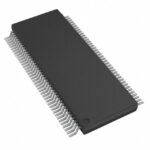 SN74ALVCHG162280GR
The activity of extra discounts on wholesale prices is in full swing…
Please fill in your contact information and we will send you the latest wholesale price list.







