 ChipApex | Global Electronic Components Supplier

SEARCH
Search Product
Search Post
— IC芯片 | 连接器 | 传感器 | 被动器件 —
Search productSearch post
— IC芯片 | 连接器 | 传感器 | 被动器件 —
Consult the customer manager about the wholesale price.
consultation hotline:86-132-6715-2157
email:[email protected]
Contact the product manager for consultation. One-stop consultation is available.
Do you want a lower wholesale price? Please send us your inquiry and we will reply immediately.
The SN74CB3Q16244DLR is a 16-bit FET bus switch manufactured by Texas Instruments. It operates within a low-voltage range of 2.5 V to 3.3 V and features high-bandwidth performance suitable for data-intensive applications. The device utilizes a 48-pin TSSOP package with an exposed pad, designed for surface-mount assembly. It supports bidirectional data flow and includes an active-low enable function to control signal transmission. The component is rated for operation across an industrial temperature range from -40°C to +85°C.
Verify the specific suffix 'DLR' corresponds to the tape-and-reel packaging format intended for automated assembly processes. Confirm that the 48-TSSOP package dimensions match the target PCB footprint requirements. Ensure the voltage rating aligns with the system's 2.5-V or 3.3-V power rails. Check for RoHS compliance status if environmental regulations apply to the final product deployment.
Select this component when designing circuits that require multiple parallel data lines to be switched simultaneously between two nodes. The 16-bit configuration reduces board space compared to using individual single-bit switches. Consider the low on-resistance characteristics for maintaining signal integrity in high-frequency applications. Evaluate the thermal performance of the TSSOP package relative to the expected current load.
This part belongs to the SN74CB3Q series of low-voltage bus switches from Texas Instruments. The series is engineered for portable and battery-operated devices where minimizing power consumption is critical. It serves as a direct replacement for older logic families in modern low-voltage designs, offering improved speed and lower static power dissipation while maintaining compatibility with standard digital interfaces.
Consult official substitution guides for equivalent parts within the CB3Q family. Verify pinout compatibility before replacing with similar 16-bit switches from other manufacturers. Ensure voltage levels and package dimensions are identical to avoid redesigning the printed circuit board layout.
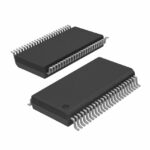 SN74CB3Q16244DLR

The activity of extra discounts on wholesale prices is in full swing…
Please fill in your contact information and we will send you the latest wholesale price list.






