 ChipApex | Global Electronic Components Supplier

SEARCH
Search Product
Search Post
— IC芯片 | 连接器 | 传感器 | 被动器件 —
Search productSearch post
— IC芯片 | 连接器 | 传感器 | 被动器件 —
Consult the customer manager about the wholesale price.
consultation hotline:86-132-6715-2157
email:[email protected]
Contact the product manager for consultation. One-stop consultation is available.
Do you want a lower wholesale price? Please send us your inquiry and we will reply immediately.
The SN74CBT3125D is a quadruple FET bus switch manufactured by Texas Instruments, designed for high-speed data routing in digital systems. It operates within a supply voltage range of 2.7 V to 3.6 V and supports bidirectional signal transmission across four independent channels. The device features low on-resistance and minimal propagation delay, ensuring efficient signal integrity. Packaged in a 14-pin SOIC format, it is suitable for surface-mount applications requiring compact footprints and reliable performance in consumer electronics and industrial control environments.
Verify the exact package type and temperature grade against the datasheet before procurement. Confirm RoHS compliance status as per the latest manufacturer documentation. Ensure the ordering suffix matches the required reel or tube quantity specifications. Cross-reference the part number with official Texas Instruments databases to avoid counterfeit components. Check for any recent lifecycle notices regarding obsolescence or alternative recommendations.
Select this component when designing circuits that require multiple isolated bidirectional paths at 3.3 V logic levels. Consider the SN74CBT3125D for applications demanding low insertion loss and fast switching speeds. Evaluate the package constraints to ensure compatibility with PCB layout requirements. Compare propagation delays and on-resistance values against system timing budgets to confirm suitability for high-frequency operations.
This part belongs to the SN74CBT3125 family of quadruple bus switches from Texas Instruments. It is engineered for use in systems where signal routing between different voltage domains or isolated sections is necessary. The device complements other logic families by providing dedicated switching functionality without complex control logic. Its design focuses on minimizing power dissipation while maintaining signal fidelity in dense electronic assemblies.
SN74CBT3125PWRE4
The maximum supply voltage is 3.6 V, with an operating range typically specified from 2.7 V to 3.6 V.
Yes, all four channels are designed for bidirectional signal transmission, allowing data to flow in either direction based on the control inputs.
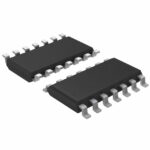 SN74CBT3125D

The activity of extra discounts on wholesale prices is in full swing…
Please fill in your contact information and we will send you the latest wholesale price list.






