 ChipApex | Global Electronic Components Supplier

SEARCH
Search Product
Search Post
— IC芯片 | 连接器 | 传感器 | 被动器件 —
Search productSearch post
— IC芯片 | 连接器 | 传感器 | 被动器件 —
Consult the customer manager about the wholesale price.
consultation hotline:86-132-6715-2157
email:[email protected]
Contact the product manager for consultation. One-stop consultation is available.
Do you want a lower wholesale price? Please send us your inquiry and we will reply immediately.
The SN74CBT3125PWR is a quadruple bus switch manufactured by Texas Instruments, designed for high-speed digital signal routing. It operates within a supply voltage range of 4.5 V to 5.5 V and features four independent single-pole single-throw (SPST) switches. The device utilizes FET technology to provide low on-resistance and minimal signal distortion. It supports bidirectional data flow and includes active pull-up and pull-down resistors to maintain defined logic levels when the switch is in the off state. The component is housed in a 14-TSSOP surface-mount package.
Verify the specific suffix 'PWR' indicates the tape-and-reel packaging format distinct from tube variants. Confirm RoHS compliance status through official manufacturer documentation prior to integration. Ensure the operating temperature range aligns with system thermal requirements. Cross-reference the datasheet revision date to validate parameter accuracy against current production standards.
Select this component when a 5V logic interface requires multiple independent signal paths with low insertion loss. The integrated pull-up/down resistors simplify circuit design by eliminating external components for undefined states. Consider the TSSOP-14 package constraints for PCB layout density. Verify that the required signal frequency falls within the specified bandwidth limits for optimal performance.
This part belongs to the SN74CBT3125C family of quadruple bus switches. It serves as a standard solution for managing multiple data lines in 5V digital environments. The device complements other Texas Instruments logic families by offering dedicated switching capabilities rather than general-purpose buffering. It is commonly used alongside level shifters and drivers in complex digital architectures.
SN74CBT3125PW is a pin-compatible alternative available in tube packaging. SN74CBT3125CDW offers the same functionality in a SOIC-14 package. Verify electrical parameters and package dimensions before substituting to ensure mechanical fit and signal integrity compatibility.
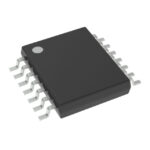 SN74CBT3125PWR

The activity of extra discounts on wholesale prices is in full swing…
Please fill in your contact information and we will send you the latest wholesale price list.





