 ChipApex | Global Electronic Components Supplier
SEARCH
Search Product
Search Post
— IC芯片 | 连接器 | 传感器 | 被动器件 —
Search productSearch post
— IC芯片 | 连接器 | 传感器 | 被动器件 —
Consult the customer manager about the wholesale price.
consultation hotline:86-132-6715-2157
email:[email protected]
Contact the product manager for consultation. One-stop consultation is available.
Do you want a lower wholesale price? Please send us your inquiry and we will reply immediately.
The SN74CBT3345CDBR is an octal FET bus switch manufactured by Texas Instruments, housed in a 20-pin SSOP package. It operates within a supply voltage range of 4 V to 5.5 V and supports data I/O signaling levels from 0 V to 5 V. The device features bidirectional data flow with near-zero propagation delay, characterized by a maximum tpd of 0.24 ns at 4 V and 0.15 ns at 5 V. It exhibits low ON-state resistance (ron) ranging from 3 Ω to 12 Ω depending on conditions, and maintains a typical off-state input/output capacitance of 5.5 pF. Designed for industrial environments, it functions reliably between -40°C and +85°C.
Verify that the specific orderable part number matches the required SSOP-20 package configuration. Confirm compliance with RoHS standards and lead finish specifications (CU NIPDAU). Ensure the operating temperature range aligns with system requirements (-40°C to +85°C). Cross-reference moisture sensitivity level ratings and recommended storage conditions prior to assembly.
Select this component for applications requiring high-speed bidirectional switching with minimal signal distortion. The low ON-state resistance and capacitance make it suitable for maintaining signal integrity across data buses. Verify control input compatibility with existing logic families, as the device accepts TTL or 5-V/3.3-V CMOS signals directly without additional level shifting.
This device belongs to the SN74CBT3345C series of high-speed TTL-compatible FET bus switches. It is designed to provide efficient data path management in digital systems. The 'DBR' suffix indicates the specific SSOP package type and tape-and-reel packaging format, distinguishing it from tube-packed variants like the CDB or CPW.
SN74CBT3345CDWR
The SN74CBT3345C includes active undershoot-protection circuitry on the A and B ports. This circuitry senses undershoot events up to -2 V and ensures the switch remains in the correct OFF state to maintain isolation.
The Ioff feature allows the device to be fully specified for partial-power-down applications. It prevents damaging current from backflowing through the device when it is powered down, ensuring isolation during power-off states.
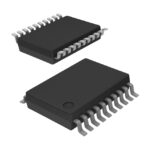 SN74CBT3345CDBR
The activity of extra discounts on wholesale prices is in full swing…
Please fill in your contact information and we will send you the latest wholesale price list.







