 ChipApex | Global Electronic Components Supplier
SEARCH
Search Product
Search Post
— IC芯片 | 连接器 | 传感器 | 被动器件 —
Search productSearch post
— IC芯片 | 连接器 | 传感器 | 被动器件 —
Consult the customer manager about the wholesale price.
consultation hotline:86-132-6715-2157
email:[email protected]
Contact the product manager for consultation. One-stop consultation is available.
Do you want a lower wholesale price? Please send us your inquiry and we will reply immediately.
The SN74CBT6845CDBR is an 8-bit TTL-compatible FET bus switch manufactured by Texas Instruments. It operates within a supply voltage range of 4 V to 5.5 V and supports bidirectional data flow with near-zero propagation delay. The device features low ON-state resistance, typically 3 Ω at VCC = 4.5 V, and low input/output capacitance of 5.5 pF typical. It includes active undershoot protection for off-isolation on A and B ports up to −2 V. The B-port outputs are precharged by the bias voltage (BIASV) to minimize signal distortion during live insertion and hot-plugging events.
Verify that the ordering suffix DBR corresponds specifically to the SSOP-20 tape and reel package configuration. Confirm the operating temperature range matches the application requirements of -40°C to +85°C. Ensure control inputs are tied to VCC or GND to maintain proper device operation. Check for RoHS compliance status if required by environmental regulations.
Select this component when designing high-speed digital interfaces requiring bidirectional switching with minimal signal degradation. The device is suitable for applications needing low ON-state resistance and low capacitance to preserve signal integrity. Consider the single output-enable pin architecture for simplified control logic in bus management designs.
This part belongs to the SN74CBT6845C series of high-speed FET bus switches from Texas Instruments. It is designed as a replacement for legacy bus transceivers where lower power consumption and faster switching speeds are required. The device integrates specific protection features not found in standard bus switches, making it distinct within the family.
SN74CBT6845CDW is available in a tube-packaged SOIC variant.
The B port is precharged to a user-selectable bias voltage (BIASV) through an equivalent 10-kΩ resistor when OE is high. This ensures any glitch produced by insertion does not cross the input threshold region of receivers on the active bus.
The Ioff feature ensures that damaging current will not backflow through the device when it is powered down, providing isolation during power-off conditions for partial-power-down applications.
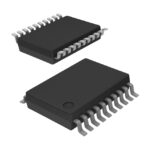 SN74CBT6845CDBR
The activity of extra discounts on wholesale prices is in full swing…
Please fill in your contact information and we will send you the latest wholesale price list.





