 ChipApex | Global Electronic Components Supplier
SEARCH
Search Product
Search Post
— IC芯片 | 连接器 | 传感器 | 被动器件 —
Search productSearch post
— IC芯片 | 连接器 | 传感器 | 被动器件 —
Consult the customer manager about the wholesale price.
consultation hotline:86-132-6715-2157
email:[email protected]
Contact the product manager for consultation. One-stop consultation is available.
Do you want a lower wholesale price? Please send us your inquiry and we will reply immediately.
The SN74CBTR16861DGGR is a 20-bit FET bus switch from the Widebus family, organized as two independent 10-bit switches. It operates on a single supply voltage ranging from 4 V to 5.5 V and supports an operating temperature range of -40°C to 85°C. The device features TTL-compatible input levels and includes equivalent 25-Ω series resistors to reduce signal reflection noise. Electrical characteristics specify a typical on-state resistance (ron) of 33 Ω at VCC = 4.5 V with II = 30 mA, and a maximum propagation delay (tpd) of 1.25 ns at VCC = 5 V.
Verify the specific ordering suffix against the manufacturer's current documentation to ensure correct package type and tape-and-reel specifications. Confirm that the component status remains active for new designs by checking the latest production data release. Ensure compatibility with the required supply voltage and thermal operating conditions before finalizing procurement.
Select this component when a 20-bit bidirectional bus switch is required within a 4 V to 5.5 V supply range. The integrated 25-Ω resistors make it suitable for applications needing reduced signal reflections without external components. Verify that the 48-pin TSSOP package dimensions fit the available PCB footprint and that the TTL-compatible input thresholds align with the system logic levels.
This device belongs to Texas Instruments' Widebus family, designed for high-density bus switching applications. It utilizes FET technology to achieve low on-resistance and fast switching speeds. The SN74CBTR16861DGGR variant specifically denotes the 48-pin TSSOP package configuration supplied in a tape-and-reel format for automated assembly processes.
Public confirmed substitute part numbers are not provided in the source material.
The device incorporates equivalent 25-Ω series resistors internally to reduce signal-reflection noise, which eliminates the requirement for external terminating resistors.
When the output-enable (OE) input is low, the switch connects port A to port B. When OE is high, the switch disconnects, placing the ports in a high-impedance state.
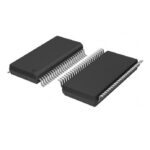 SN74CBTR16861DGGR
The activity of extra discounts on wholesale prices is in full swing…
Please fill in your contact information and we will send you the latest wholesale price list.





