 ChipApex | Global Electronic Components Supplier
SEARCH
Search Product
Search Post
— IC芯片 | 连接器 | 传感器 | 被动器件 —
Search productSearch post
— IC芯片 | 连接器 | 传感器 | 被动器件 —
Consult the customer manager about the wholesale price.
consultation hotline:86-132-6715-2157
email:[email protected]
Contact the product manager for consultation. One-stop consultation is available.
Do you want a lower wholesale price? Please send us your inquiry and we will reply immediately.
The SN74F08DRG4 is a quadruple 2-input positive-AND gate manufactured by Texas Instruments. It belongs to the 74F logic series and utilizes BiCMOS technology. The device operates within a supply voltage range of 4.5 V to 5.5 V. It features a low-level output current of 20 mA and a high-level output current of -1 mA. The propagation delay is specified at 6.6 ns. The component is housed in a 14-SOIC package and supports surface-mount installation. It functions reliably across an operating temperature range from 0°C to +70°C.
Verify the specific suffix G4 indicates RoHS compliance and green manufacturing options as per Texas Instruments documentation. Confirm the SOIC-14 package dimensions match the target PCB footprint. Ensure the operating temperature range meets the environmental requirements of the final assembly. Cross-reference the manufacturer part number with authorized distributors to ensure authenticity and traceability.
Select this component when high-speed logic performance is required within standard 5V logic families. The F series offers faster switching speeds compared to LS or ALS variants. Verify that the 20 mA output drive strength is sufficient for the connected load capacitance. Consider the 14-pin SOIC package constraints during layout design to ensure adequate thermal dissipation and mechanical stability.
This part is part of the Texas Instruments 74F series, known for high-speed performance in standard TTL-compatible logic applications. The DRG4 designation specifies the tape-and-reel packaging format and RoHS-compliant construction. It serves as a direct functional replacement for other 74F08 devices in compatible packages, maintaining pinout consistency while offering updated environmental compliance.
SN74F08DR is the non-RoHS equivalent with identical electrical characteristics. SN74ALS08DR offers similar functionality but with lower power consumption and slightly slower speed. SN74LS08DR provides comparable performance with higher noise immunity but significantly slower propagation delays.
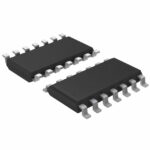 SN74F08DRG4
The activity of extra discounts on wholesale prices is in full swing…
Please fill in your contact information and we will send you the latest wholesale price list.





