 ChipApex | Global Electronic Components Supplier
SEARCH
Search Product
Search Post
— IC芯片 | 连接器 | 传感器 | 被动器件 —
Search productSearch post
— IC芯片 | 连接器 | 传感器 | 被动器件 —
Consult the customer manager about the wholesale price.
consultation hotline:86-132-6715-2157
email:[email protected]
Contact the product manager for consultation. One-stop consultation is available.
Do you want a lower wholesale price? Please send us your inquiry and we will reply immediately.
The SN74HC157DR is a quadruple 2-line to 1-line data selector/multiplexer housed in a 16-pin SOIC package. It operates within a supply voltage range of 2V to 6V and supports an operating temperature from -40°C to 85°C. The device features low input current (1µA max) and typical propagation delay of 11ns at 5V. Outputs can drive up to 15 LSTTL loads with ±6mA drive capability at 5V. Maximum ICC consumption is 80µA.
Verify the specific ordering suffix 'DR' corresponds to the SOIC-16 package and tape-and-reel carrier format. Confirm the operating temperature range (-40°C to 85°C) matches system requirements. Ensure compatibility with the 2V–6V supply voltage range and check for RoHS compliance status indicated by the NIPDAU lead finish. Validate that the device status is listed as Active Production in official TI documentation before procurement.
Select this component when a quadruple 2-to-1 multiplexer function is required in a compact surface-mount form factor. It is suitable for systems needing TTL-compatible inputs and low power consumption. Consider the 16-pin SOIC package constraints and thermal resistance values if high ambient temperatures are expected. Ensure the application does not require military-grade temperature ranges, which necessitate the SN54 series variants.
The SN74HC157 belongs to the Texas Instruments HC (High-speed CMOS) logic family. It is part of the SNx4HC157 series, which includes multiple package options such as SSOP, PDIP, and TSSOP. The 'D' suffix denotes the SOIC package, while 'R' indicates tape-and-reel packaging. This device serves as a standard digital logic solution for data selection tasks in commercial electronics.
SN74HC157DBR: Alternative SSOP-16 package version of the same logical function.
A high level at the strobe (G) terminal forces all Y outputs low, regardless of the state of the address select or data inputs.
Standard CMOS inputs must not be left floating. Unused inputs should be terminated at VCC or GND to prevent excessive power consumption and potential oscillations.
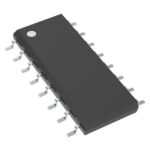 SN74HC157DR
The activity of extra discounts on wholesale prices is in full swing…
Please fill in your contact information and we will send you the latest wholesale price list.





