 ChipApex | Global Electronic Components Supplier
SEARCH
Search Product
Search Post
— IC芯片 | 连接器 | 传感器 | 被动器件 —
Search productSearch post
— IC芯片 | 连接器 | 传感器 | 被动器件 —
Consult the customer manager about the wholesale price.
consultation hotline:86-132-6715-2157
email:[email protected]
Contact the product manager for consultation. One-stop consultation is available.
Do you want a lower wholesale price? Please send us your inquiry and we will reply immediately.
The SN74HC4851PWR is an eight-channel CMOS analog multiplexer/demultiplexer manufactured by Texas Instruments in a 16-pin TSSOP package. It operates on a single supply voltage ranging from 2V to 5.5V and supports signal paths within the same range. The device features injection-current effect control, allowing disabled channel inputs to exceed the supply voltage without affecting the enabled channel. Key electrical parameters include a maximum on-state resistance of 195 ohms at 5V, off-state leakage current up to 1µA, and propagation delay times between 8.6ns and 32ns depending on voltage. It provides latch-up performance exceeding 100mA per JESD 78, Class II standards.
Verify the specific ordering suffix against the manufacturer's latest Package Option Addendum to confirm active production status and material specifications. Ensure the selected variant matches the required tape and reel dimensions or tube quantities for your assembly process. Cross-reference the lead finish and moisture sensitivity level ratings with your board manufacturing requirements before finalizing procurement orders.
Select this component when system designs require handling analog signals that may transiently exceed the logic supply voltage without external protection diodes. The device is suitable for applications needing terminal compatibility with legacy '4051 series parts while offering improved injection-current isolation. Verify that the operating temperature range of -40°C to 125°C aligns with the environmental conditions of the target deployment scenario.
This part belongs to the SN74HC485x family of high-speed CMOS logic devices. It serves as a functional upgrade to standard analog multiplexers by integrating internal circuitry to manage substrate coupling effects. The PWR suffix specifically denotes the 16-lead Thin Shrink Small Outline Package (TSSOP), which is optimized for surface-mount assembly technologies.
The SN74HC4851PWR is functionally terminal-compatible with the SN74HC4051, SN74LV4051A, and CD4051B. Designers replacing these older components should verify that the new injection-current control features do not conflict with existing passive network protections.
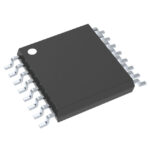 SN74HC4851PWR
The activity of extra discounts on wholesale prices is in full swing…
Please fill in your contact information and we will send you the latest wholesale price list.





