 ChipApex | Global Electronic Components Supplier
SEARCH
Search Product
Search Post
— IC芯片 | 连接器 | 传感器 | 被动器件 —
Search productSearch post
— IC芯片 | 连接器 | 传感器 | 被动器件 —
Consult the customer manager about the wholesale price.
consultation hotline:86-132-6715-2157
email:[email protected]
Contact the product manager for consultation. One-stop consultation is available.
Do you want a lower wholesale price? Please send us your inquiry and we will reply immediately.
The SN74HCT138NG4 is a 3-line to 8-line decoder/demultiplexer from the Texas Instruments SNx4HCT138 family. It operates within a supply voltage range of 4.5 V to 5.5 V and features TTL-compatible inputs with low input current (1 µA max). The device provides three enable inputs to simplify cascading and demultiplexing applications. Typical propagation delay is 17 ns at 5 V, with outputs capable of driving up to 10 LSTTL loads or ±4 mA at 5 V. Maximum supply current is 80 µA.
Verify that the ordering suffix 'G4' corresponds to lead-free packaging and RoHS compliance as indicated in manufacturer documentation. Confirm package type availability matches design requirements, as this part number typically denotes specific manufacturing revisions or environmental certifications within the HCT138 series. Cross-reference official datasheets for exact mechanical dimensions and thermal characteristics before finalizing procurement specifications.
Select this component when TTL-compatible logic levels are required alongside high-speed decoding capabilities. The HCT series ensures compatibility with standard 5 V TTL systems while offering lower power consumption than older technologies. Ensure the application benefits from the specific enable pin configuration for system expansion or demultiplexing needs without requiring additional external gates.
This device belongs to the SNx4HCT138 family of 3-line to 8-line decoders and demultiplexers manufactured by Texas Instruments. The family includes variants such as SN74HCT138N and SN74HCT138D, differing primarily in package style and operating temperature ranges. The HCT logic family is characterized by CMOS technology with TTL-compatible input thresholds, bridging the gap between legacy TTL systems and modern low-power CMOS designs.
SN74HCT138N serves as a direct functional equivalent within the same product family. Verify package compatibility and ensure that any substitute maintains the required 4.5 V to 5.5 V operating voltage range and TTL input compatibility for seamless integration into existing circuit designs.
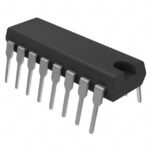 SN74HCT138NG4
The activity of extra discounts on wholesale prices is in full swing…
Please fill in your contact information and we will send you the latest wholesale price list.






