 ChipApex | Global Electronic Components Supplier
SEARCH
Search Product
Search Post
— IC芯片 | 连接器 | 传感器 | 被动器件 —
Search productSearch post
— IC芯片 | 连接器 | 传感器 | 被动器件 —
Consult the customer manager about the wholesale price.
consultation hotline:86-132-6715-2157
email:[email protected]
Contact the product manager for consultation. One-stop consultation is available.
Do you want a lower wholesale price? Please send us your inquiry and we will reply immediately.
The SN74LS684DW is an 8-bit magnitude comparator from the 74LS series, manufactured by onsemi. It operates within a supply voltage range of 4.85V to 5.25V and features low power Schottky technology. The device provides P=Q and P>Q outputs in active-low configuration. It exhibits a maximum propagation delay of 23ns at 5V with 45pF load. Output currents are specified as 400µA high and 24mA low. It is housed in a 20-SOIC package and supports surface mount installation.
Verify component authenticity through authorized onsemi distributors or certified suppliers. Confirm the part number matches SN74LS684DW exactly, noting the 20-SOIC package and LPS series designation. Check manufacturing date codes and RoHS compliance status, as legacy LS components may have specific environmental classifications. Ensure storage conditions align with semiconductor handling standards to prevent moisture sensitivity issues prior to soldering.
Select this component when designing systems requiring dedicated 8-bit magnitude comparison functionality with active-low outputs. The 74LS series offers a balance of speed and power dissipation suitable for general-purpose digital logic. Consider the 20-SOIC package dimensions for PCB layout constraints. Evaluate compatibility with existing 5V logic families if interfacing with other TTL-compatible devices in the circuit design.
This device belongs to the SN74LS68x family of 8-bit magnitude comparators, which includes variants like the SN74LS682 and SN74LS688. These components are designed for comparing two eight-bit binary or BCD words. The SN74LS684DW specifically distinguishes itself by providing both equality (P=Q) and greater-than (P>Q) outputs, whereas other family members may offer different output combinations such as identity-only comparisons.
Compatible substitutes include SN74LS682DW and SN74LS688DW from onsemi or equivalent manufacturers. Verify that replacement parts maintain the same 20-SOIC package and electrical characteristics. Note that while functional pinouts may be similar, output configurations differ; ensure the substitute provides the required P>Q signal if necessary.
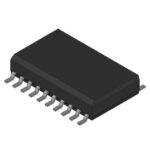 SN74LS684DW
The activity of extra discounts on wholesale prices is in full swing…
Please fill in your contact information and we will send you the latest wholesale price list.





