 ChipApex | Global Electronic Components Supplier
SEARCH
Search Product
Search Post
— IC芯片 | 连接器 | 传感器 | 被动器件 —
Search productSearch post
— IC芯片 | 连接器 | 传感器 | 被动器件 —
Consult the customer manager about the wholesale price.
consultation hotline:86-132-6715-2157
email:[email protected]
Contact the product manager for consultation. One-stop consultation is available.
Do you want a lower wholesale price? Please send us your inquiry and we will reply immediately.
The SN74LV123ADG4 is a dual monostable multivibrator from the Texas Instruments 74LV series, housed in a 16-pin SOIC package. It operates on a supply voltage range of 2 V to 5.5 V and features Schmitt-trigger inputs for noise immunity. The device provides two independent circuits with a propagation delay of 13 ns and output drive currents of ±12 mA. It supports an operating temperature range from -40°C to 125°C and complies with RoHS3 standards.
Verify the specific suffix 'DG4' against official Texas Instruments documentation to confirm it denotes a lead-free or tape-and-reel variant within the SN74LV123 family. Ensure the ordering part number matches the exact package and environmental specifications required for the design. Cross-reference with the manufacturer's current datasheet to validate availability and any recent product change notices affecting this specific marking code.
Select this component when dual independent timing channels are required in a low-voltage logic environment. The LV series offers compatibility with both 3.3 V and 5 V systems. Consider the 16-SOIC package for surface-mount assembly constraints. Verify that the 13 ns propagation delay meets the system's timing requirements and that the ±12 mA output current is sufficient for the load capacitance.
This part belongs to the SN74LV123A family of dual retriggerable monostable multivibrators. The 'DG4' suffix typically indicates a specific manufacturing revision or packaging option, such as lead-free composition or reel type, within the standard SN74LV123AD functional scope. It shares electrical characteristics with the base SN74LV123AD model but may differ in physical handling or environmental compliance markings.
SN74LV123ADRG4
Yes, the SN74LV123A family devices are designed to be retriggerable, allowing the pulse width to be extended by new trigger events before the previous pulse has ended.
The device features Schmitt-trigger inputs, which provide improved noise immunity and cleaner switching compared to standard logic inputs.
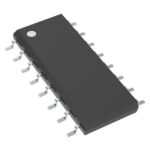 SN74LV123ADG4
The activity of extra discounts on wholesale prices is in full swing…
Please fill in your contact information and we will send you the latest wholesale price list.






