 ChipApex | Global Electronic Components Supplier
SEARCH
Search Product
Search Post
— IC芯片 | 连接器 | 传感器 | 被动器件 —
Search productSearch post
— IC芯片 | 连接器 | 传感器 | 被动器件 —
Consult the customer manager about the wholesale price.
consultation hotline:86-132-6715-2157
email:[email protected]
Contact the product manager for consultation. One-stop consultation is available.
Do you want a lower wholesale price? Please send us your inquiry and we will reply immediately.
The SN74LV123ATPWREP is a dual retriggerable monostable multivibrator from the Texas Instruments LV series. It operates on a supply voltage range of 2 V to 5.5 V and features Schmitt-trigger inputs for noise immunity. The device provides two independent circuits in a 16-TSSOP package, suitable for surface-mount installation. It supports propagation delays as low as 14 ns and offers output currents of ±12 mA. Designed for industrial environments, it functions within a temperature range of -40°C to +125°C and meets AEC-Q100 automotive qualification standards.
Verify the specific suffix 'REP' indicates Mil Enhanced status against official manufacturer documentation. Confirm RoHS compliance details and REACH status directly from the datasheet. Ensure the 16-TSSOP package dimensions match the design footprint requirements. Check for any specific handling instructions related to its automotive qualification level.
Select this component when automotive qualification (AEC-Q100) is required for monostable multivibrator functions. It is appropriate for designs needing Schmitt-trigger inputs to handle noisy signals. Consider the 16-TSSOP package for space-constrained surface-mount layouts. Verify that the 2 V to 5.5 V supply range aligns with the system power rails.
This part belongs to the SN74LV123 family of dual retriggerable monostable multivibrators. The 'A' denotes an improved version, while 'REP' signifies a Mil Enhanced variant. It shares functional similarities with standard commercial versions but targets higher reliability applications. The LV series ensures compatibility with low-voltage logic systems.
The REP suffix typically denotes a Mil Enhanced version of the component, indicating stricter manufacturing controls and reliability standards compared to standard commercial parts.
Yes, the SN74LV123ATPWREP is qualified under the AEC-Q100 standard, making it suitable for automotive electronic systems.
Yes, the SN74LV123ATPWREP features Schmitt-trigger inputs on all channels to improve noise immunity during signal transitions.
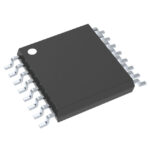 SN74LV123ATPWREP
The activity of extra discounts on wholesale prices is in full swing…
Please fill in your contact information and we will send you the latest wholesale price list.






