 ChipApex | Global Electronic Components Supplier
SEARCH
Search Product
Search Post
— IC芯片 | 连接器 | 传感器 | 被动器件 —
Search productSearch post
— IC芯片 | 连接器 | 传感器 | 被动器件 —
Consult the customer manager about the wholesale price.
consultation hotline:86-132-6715-2157
email:[email protected]
Contact the product manager for consultation. One-stop consultation is available.
Do you want a lower wholesale price? Please send us your inquiry and we will reply immediately.
The SN74LV4051ATPWRQ1 is an automotive-grade CMOS analog multiplexer and demultiplexer manufactured by Texas Instruments. It features eight independent channels configured as a single 8:1 circuit in a 16-pin TSSOP package. The device operates on a single supply voltage ranging from 2 V to 5.5 V, supporting signal amplitudes up to the peak supply voltage. Key electrical specifications include a maximum on-resistance of 75 Ohms with a channel-to-channel matching of 1.3 Ohms, ensuring consistent signal transmission. The component exhibits a -3 dB bandwidth of 35 MHz and typical propagation delays of 7 ns, with maximum switch times of 14 ns for both turn-on and turn-off states. It functions reliably across an extended industrial temperature range of -40°C to +105°C.
Verify the specific suffix TPWRQ1 to confirm the TSSOP-16 package and automotive grade status. Ensure compatibility with AEC-Q100 requirements if used in vehicle electronics. Check RoHS compliance documentation for environmental regulations. Confirm availability through authorized distributors to avoid counterfeit components. Validate pinout alignment during PCB layout integration.
Select this component when automotive reliability and low on-resistance are required for analog signal routing. Compare against standard commercial grades if operating conditions exceed the specified temperature range. Consider the 16-TSSOP footprint constraints during mechanical design. Evaluate power supply stability within the 2 V to 5.5 V window for optimal performance.
This part belongs to the SN74LV4051A family of analog switches. The Q1 suffix denotes automotive qualification under AEC-Q100 standards. It serves as a robust alternative to commercial variants for harsh environments. The device integrates seamlessly into mixed-signal designs requiring efficient channel selection.
SN74LV4051ATDWRQ1 (SOIC-16 package)
Each channel allows signals with amplitudes up to the peak supply voltage, which can reach 5.5 V.
Yes, the SN74LV4051ATPWRQ1 supports bidirectional transmission of both analog and digital signals.
The typical propagation delay time is 7 ns.
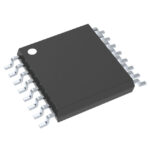 SN74LV4051ATPWRQ1
The activity of extra discounts on wholesale prices is in full swing…
Please fill in your contact information and we will send you the latest wholesale price list.





