 ChipApex | Global Electronic Components Supplier
SEARCH
Search Product
Search Post
— IC芯片 | 连接器 | 传感器 | 被动器件 —
Search productSearch post
— IC芯片 | 连接器 | 传感器 | 被动器件 —
Consult the customer manager about the wholesale price.
consultation hotline:86-132-6715-2157
email:[email protected]
Contact the product manager for consultation. One-stop consultation is available.
Do you want a lower wholesale price? Please send us your inquiry and we will reply immediately.
The SN74LVC257AMPWREP is a quadruple 2-line to 1-line data selector/multiplexer with 3-state outputs manufactured by Texas Instruments. It belongs to the LVC logic series and features a TSSOP-14 package, although it contains four independent circuits. The device operates within a supply voltage range of 1.65 V to 5.5 V. Key electrical parameters include a maximum propagation delay of 4.6 ns at 3.3 V, low static current of 10 uA, and an output ground bounce (VOLP) typically less than 0.8 V. It supports extended temperature performance from -55°C to +125°C.
Verify the exact ordering suffix 'REP' indicates military/extended reliability grade specifications compared to standard commercial variants. Confirm package type is TSSOP-14 despite the 'quad' designation implying multiple circuits; cross-reference datasheet mechanical drawings. Ensure supplier documentation matches the specific TI part number SN74LVC257AMPWREP to avoid confusion with non-rep variants.
Select this component when quadruple 2-to-1 multiplexing with three-state outputs is required in space-constrained designs. The LVC series offers speed and power efficiency suitable for battery-operated devices. Consider the extended temperature range (-55°C to +125°C) if operating in harsh environments. Verify voltage levels match system requirements between 1.65 V and 5.5 V.
This part is part of the SN74LVC257A family of multiplexers. The 'REP' suffix typically denotes a reliability-enhanced or military-grade version produced under specific quality controls. It shares functional similarities with other LVC series logic but is distinct in its packaging and potential environmental ratings compared to standard commercial equivalents like SN74LVC257APWR.
SN74LVC257APWRG4 is a compatible alternative within the same logic family offering similar functionality. Check if the standard commercial grade meets application requirements instead of the REP variant. Ensure pinout compatibility remains identical for direct substitution without PCB redesign.
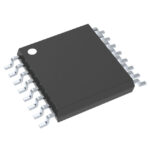 SN74LVC257AMPWREP
The activity of extra discounts on wholesale prices is in full swing…
Please fill in your contact information and we will send you the latest wholesale price list.





