 ChipApex | Global Electronic Components Supplier

SEARCH
Search Product
Search Post
Search productSearch post
Consult the customer manager about the wholesale price.
consultation hotline:86-132-6715-2157
email:[email protected]
Contact the product manager for consultation. One-stop consultation is available.
Do you want a lower wholesale price? Please send us your inquiry and we will reply immediately.
SN75150D is listed in the Drivers, Receivers, Transceivers range at ChipApex. The manufacturer field lists Texas Instruments. Its product description is IC TRANSCEIVER 2/0 8SOIC. Review the specifications below when checking this part for your BOM.
The SN75150D is a monolithic dual line driver manufactured by Texas Instruments, designed to meet TIA/EIA-232-F and ITU Recommendation V.28 interface standards. It operates from ±12-V power supplies (range: ±10.8 V to ±13.2 V) and supports data transmission rates up to 20 kbits/s with a full 2500-pF load. The device features two inverting outputs with a common strobe input, compatible with most TTL families. Electrical characteristics include a maximum transition time of 2 μs through the ±3-V region under full capacitive loading. It withstands sustained output short circuits to any low-impedance voltage between –25 V and +25 V. The component is characterized for operation within an ambient temperature range of 0°C to 70°C.
Verify the specific ordering suffix against the manufacturer's package option addendum to confirm the correct carrier type. The 'D' suffix indicates a SOIC package supplied in tubes, while the 'DR' suffix denotes the same package in tape and reel format. Ensure the selected variant matches the required manufacturing assembly process and quantity constraints.
Select this component when designing interfaces requiring compliance with RS-232 specifications using standard ±12-V supply rails. The device is suitable for applications needing robust protection against output short circuits and high-voltage transients. Verify that the required data rate does not exceed 20 kbits/s under the target capacitive load conditions.
The SN75150 belongs to the legacy family of RS-232 line drivers produced by Texas Instruments. It serves as a foundational component for serial communication hardware defined by older industry standards. The 'D' designation specifically identifies the small-outline integrated circuit package configuration available for surface-mount assembly.
The SN75150D is functionally equivalent to the SN75150P (PDIP package). Other variants include SN75150DR and SN75150D.A. Cross-referencing requires matching the dual-driver topology, RS-232 compliance, and operating voltage ranges.
The maximum transition time through the 3-V to –3-V transition region is 2 μs when driving a full 2500-pF load.
The common strobe input controls both line drivers simultaneously, allowing for synchronized disabling or enabling of the inverting outputs.
Yes, the slew rate can be controlled by connecting an external capacitor directly at the output pin.
Explore related parts through Interface, Integrated Circuits (ICs), all product categories, ChipApex homepage.
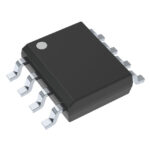 SN75150D

The activity of extra discounts on wholesale prices is in full swing…
Please fill in your contact information and we will send you the latest wholesale price list.





