 ChipApex | Global Electronic Components Supplier

SEARCH
Search Product
Search Post
Search productSearch post
Consult the customer manager about the wholesale price.
consultation hotline:86-132-6715-2157
email:[email protected]
Contact the product manager for consultation. One-stop consultation is available.
Do you want a lower wholesale price? Please send us your inquiry and we will reply immediately.
SN75970B2DL is listed in the Drivers, Receivers, Transceivers range at ChipApex. The manufacturer field lists Texas Instruments. Its product description is IC TRANSCEIVER HALF 9/9 56SSOP. Review the specifications below when checking this part for your BOM.
The SN75970B2DL is a SCSI differential converter-control IC manufactured by Texas Instruments. It provides high-voltage differential SCSI connectivity from single-ended controllers when used with companion data transceivers like the SN75971B. The device integrates nine RS-485 differential transceivers and nine TTL/CMOS-compatible transceivers, along with control logic, a state machine, and a 20-MHz oscillator. It operates on a 5-V supply (4.75 V to 5.25 V) within a commercial temperature range of 0°C to 70°C. Key electrical parameters include a typical disabled supply current of 32 mA, ESD protection up to 12 kV on bus pins, and positive/negative current limiting.
Verify the specific suffix '2DL' against the manufacturer's official documentation to confirm package type and speed grade. Ensure the ordering information matches the exact part number required for your design specifications. Cross-reference with authorized distributors to confirm availability and authenticity.
Select this component when designing a SCSI differential node requiring integrated control logic for nine channels. It is suitable for applications needing conversion from single-ended controllers to differential buses without external decoding logic. Consider the SSOP/TSSOP packaging constraints and the requirement for an external crystal or clock source for the internal oscillator.
The SN75970B belongs to the SN75970 family of SCSI differential converters. It is designed to work in conjunction with the SN75971B data transceiver. This combination allows for the implementation of a complete 16-bit differential SCSI interface using only three devices: two data transceivers and one control transceiver.
Public confirmed substitute part numbers are not available in the provided documentation. Verify compatibility with existing designs before considering alternative components.
The DSENS (differential sense) pin initializes the internal latches and disables all drivers when a low-level input is detected. It prevents issues if a single-ended cable is inadvertently connected to a differential connector.
The internal state machine monitors bus control signals like BBSY and BSEL. It enters an arbitration state upon detecting a bus-free condition and manages transitions based on signal assertions, utilizing a timeout timer to prevent indefinite waiting.
The A side inputs are TTL- or CMOS-level compatible. High-level input voltage (VIH) is typically 2 V minimum, and low-level input voltage (VIL) is typically 0.8 V maximum.
Explore related parts through Interface, Integrated Circuits (ICs), all product categories, ChipApex homepage.
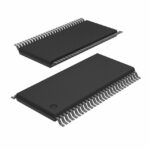 SN75970B2DL

The activity of extra discounts on wholesale prices is in full swing…
Please fill in your contact information and we will send you the latest wholesale price list.





