 ChipApex | Global Electronic Components Supplier
SEARCH
Search Product
Search Post
— IC芯片 | 连接器 | 传感器 | 被动器件 —
Search productSearch post
— IC芯片 | 连接器 | 传感器 | 被动器件 —
Consult the customer manager about the wholesale price.
consultation hotline:86-132-6715-2157
email:[email protected]
Contact the product manager for consultation. One-stop consultation is available.
Do you want a lower wholesale price? Please send us your inquiry and we will reply immediately.
The SN75LVPE5412 is a four-channel linear redriver with an integrated 1:2 demultiplexer designed for PCIe 5.0 and other interfaces up to 32Gbps. It operates on a single 3.3V supply, consuming 720mW in active mode. The device features continuous-time linear equalizers (CTLE) providing up to 24dB boost at 16GHz. Key electrical parameters include a propagation delay of 90ps, additive random jitter of 55fs RMS, and differential return loss of -10dB from 8-16GHz. It supports x4, x8, and x16 bus widths and functions within a temperature range of -40°C to 85°C.
Verify the specific ordering suffix RUAT corresponds to the 42-pin WQFN package. Confirm that the component meets the required operating temperature range of -40°C to 85°C. Ensure compatibility with the system's 3.3V power rail and check if SMBus/I2C configuration is needed versus pin-strapped operation. Validate that the package dimensions fit the PCB layout constraints.
Select this component when supporting PCIe 5.0 or higher speed interfaces up to 32Gbps is required. It is suitable for applications needing lane demultiplexing and signal conditioning. Consider the low power consumption and lack of heat sink requirement for thermal management. Evaluate the need for SMBus/I2C configurability versus fixed pin control based on system design complexity.
This device belongs to Texas Instruments' family of high-speed linear redrivers and repeaters. It complements the SN75LVPE5421 multiplexer for complete lane switching solutions. The series addresses signal integrity challenges in high-speed digital interconnects by compensating for channel losses and maintaining signal quality over long traces.
Public confirmed substitute part numbers are not available in the provided documentation. Verify compatibility with existing designs before considering alternative components.
The demux selection between Port A and Port B is controlled by the SEL pin. In Pin Mode, a logic low selects Port A and a logic high selects Port B.
The device provides up to 24dB of equalization boost at 16GHz when configured to the maximum setting (EQ Index 19).
Yes, the device supports configuration via SMBus/I2C secondary mode, allowing individual channel programming for equalization and flat gain.
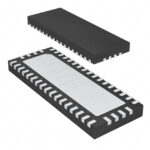 SN75LVPE5412RUAT
The activity of extra discounts on wholesale prices is in full swing…
Please fill in your contact information and we will send you the latest wholesale price list.





