 ChipApex | Global Electronic Components Supplier
SEARCH
Search Product
Search Post
— IC芯片 | 连接器 | 传感器 | 被动器件 —
Search productSearch post
— IC芯片 | 连接器 | 传感器 | 被动器件 —
Consult the customer manager about the wholesale price.
consultation hotline:86-132-6715-2157
email:[email protected]
Contact the product manager for consultation. One-stop consultation is available.
Do you want a lower wholesale price? Please send us your inquiry and we will reply immediately.
The SNJ54AHC373J is an octal transparent D-type latch with three-state outputs manufactured by Texas Instruments. It operates within a supply voltage range of 2V to 5.5V and supports a military-grade operating temperature range from -55°C to 125°C. The device features eight data inputs (D), eight corresponding outputs (Q), a latch enable input (LE), and an output enable input (OE). When LE is high, the outputs follow the inputs; when low, data is latched. The OE pin controls the high-impedance state. It utilizes a 20-pin ceramic dual in-line package (CDIP) designed for through-hole mounting.
Verify that the specific part number SNJ54AHC373J corresponds to the military-grade SN54 variant rather than the commercial SN74 series. Confirm the CDIP-20 package type matches the design requirements. Check for RoHS compliance status as indicated in manufacturer documentation, noting that military variants may have different environmental certifications compared to standard catalog parts.
Select this component for designs requiring extended temperature ranges down to -55°C and up to 125°C. Ensure the application benefits from the 2V to 5.5V operating range. Verify that the through-hole CDIP package fits the PCB layout constraints. Consider the propagation delay specifications relative to the system clock speed at the intended operating voltage.
This device belongs to the SNx4AHC373 family of octal transparent D-type latches. The 'SNJ' prefix indicates a military-grade qualification under MIL-PRF-38535 standards. It shares functional similarities with other AHC series latches but offers enhanced reliability and wider temperature tolerance suitable for defense and aerospace environments.
SNJ54AHC373FK (LCCC package)
The OE pin only controls the external output state. It does not affect the internal operations of the latches, allowing old data to be retained or new data to be entered while the outputs are in the high-impedance state.
All unused inputs must be connected to either VCC or GND to prevent undefined operational states caused by floating voltages. They should never be left unconnected.
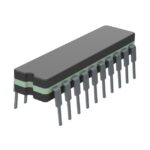 SNJ54AHC373J
The activity of extra discounts on wholesale prices is in full swing…
Please fill in your contact information and we will send you the latest wholesale price list.






