 ChipApex | Global Electronic Components Supplier

SEARCH
Search Product
Search Post
Search productSearch post
Consult the customer manager about the wholesale price.
consultation hotline:86-132-6715-2157
email:[email protected]
Contact the product manager for consultation. One-stop consultation is available.
Do you want a lower wholesale price? Please send us your inquiry and we will reply immediately.
SNJ55107AJ is listed in the Drivers, Receivers, Transceivers range at ChipApex. The manufacturer field lists Texas Instruments. Its product description is IC DUAL LINE RECEIVER. Review the specifications below when checking this part for your BOM.
The SNJ55107AJ is a dual differential line receiver manufactured by Texas Instruments, designed for high-speed data transmission systems. It features two independent channels with TTL drive capability and totem-pole outputs. The device operates over the full military temperature range of -55°C to 125°C and requires dual supply voltages of ±5 V (±4.5 V to ±5.5 V). Key electrical characteristics include a differential input sensitivity of 25 mV, a common-mode rejection ratio supporting ±3 V common-mode voltage, and propagation delays typically ranging from 17 ns to 25 ns at ±5 V supplies.
Verify that the ordering suffix 'J' corresponds to the ceramic DIP package and 'A' denotes the specific revision compatible with military temperature ranges. Confirm that the 'W' suffix variant is not required if hermetic sealing is necessary for the specific application environment. Ensure compatibility with existing board layouts for the 16-pin CDIP footprint.
Select this component when operation across the full military temperature range (-55°C to 125°C) is mandatory. Choose the SNJ55107AJ over commercial variants if long-term reliability in harsh environments is required. Consider the SN75107B or SN75108A alternatives only if commercial temperature ranges suffice or if open-collector outputs are specifically needed.
This device belongs to the SN55107A family of dual line receivers, which are unilateral replacements for older SN55107 and SN75107 models. The SNJ55107AJ specifically utilizes a ceramic package suitable for high-reliability applications. It shares functional similarities with the SN75107A but differs in thermal performance and packaging materials.
Publicly confirmed substitutes include the SN55107, SN75107, and SN75108. These devices offer similar functionality but may differ in temperature ratings or output configurations. Verify pinout compatibility and electrical specifications before substitution.
The B version includes diode-protected inputs in series with the collectors of the differential-input transistors, which prevents issues in party-line systems where power supplies might be turned off while transmission lines remain biased.
The strobe inputs (G and S) allow for receiver selection. When activated, they enable or inhibit the output based on the logic state, facilitating time multiplexing in data-bus systems.
Yes, the device can be used in unbalanced systems by applying a DC reference voltage to one input terminal and the signal to the other, though balanced systems are preferred for longer distances.
Explore related parts through Interface, Integrated Circuits (ICs), all product categories, ChipApex homepage.
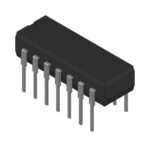 SNJ55107AJ

The activity of extra discounts on wholesale prices is in full swing…
Please fill in your contact information and we will send you the latest wholesale price list.





