 ChipApex | Global Electronic Components Supplier
SEARCH
Search Product
Search Post
— IC芯片 | 连接器 | 传感器 | 被动器件 —
Search productSearch post
— IC芯片 | 连接器 | 传感器 | 被动器件 —
Consult the customer manager about the wholesale price.
consultation hotline:86-132-6715-2157
email:[email protected]
Contact the product manager for consultation. One-stop consultation is available.
Do you want a lower wholesale price? Please send us your inquiry and we will reply immediately.
The Triad Magnetics SP-21-B is a radial audio transformer designed for high-reliability applications. It features a primary impedance of 10 kΩ center-tapped and a secondary impedance of 2 kΩ center-tapped, providing a turns ratio of 2.24:1. The device operates within a frequency range of 300 Hz to 100 kHz. Electrical specifications include a maximum current rating of 1 mA and a power rating of 50 mW (1/20 W). DC resistance values are 1.05 kΩ for the primary winding and 330 Ω for the secondary winding. The unit supports an insulation voltage of 1 kV and has a DC voltage rating of 150 V. Physical dimensions are 7.874 mm in length, 10.41 mm in width, and 11.811 mm in height.
Verify that the specific suffix '-B' aligns with the required mechanical or environmental specifications compared to the base SP-21 model. Confirm that the center-tapped configuration matches the circuit design requirements. Ensure the operating temperature range meets the application's thermal constraints. Validate compliance with relevant safety standards for the intended market.
Select this component when a 10kΩ CT to 2kΩ CT transformation is required for audio frequencies. Consider the 1 mA current limit and 50 mW power rating to ensure the transformer does not saturate under load. Evaluate the physical footprint against available board space. Compare performance against other Triad Magnetics series if different impedance ratios are needed.
The SP-21-B belongs to the Triad Magnetics SP series of audio transformers. This series is characterized by robust construction suitable for demanding environments. The product falls under the category of audio and signal transformers, specifically designed for frequency ranges starting at 300 Hz. It is part of a broader lineup offering various impedance configurations for different audio interface needs.
The SP-66 serves as a potential alternative but offers a 1:1 impedance ratio (10kΩ/10kΩ), which differs from the SP-21-B's 2.24:1 ratio. Verify that the circuit can tolerate the impedance mismatch before substituting. No other direct substitutes are confirmed in public documentation.
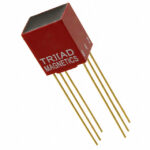 SP-21-B
The activity of extra discounts on wholesale prices is in full swing…
Please fill in your contact information and we will send you the latest wholesale price list.






