 ChipApex | Global Electronic Components Supplier
SEARCH
Search Product
Search Post
— IC芯片 | 连接器 | 传感器 | 被动器件 —
Search productSearch post
— IC芯片 | 连接器 | 传感器 | 被动器件 —
Consult the customer manager about the wholesale price.
consultation hotline:86-132-6715-2157
email:[email protected]
Contact the product manager for consultation. One-stop consultation is available.
Do you want a lower wholesale price? Please send us your inquiry and we will reply immediately.
The SST505 is a current regulating diode from the SST500 series by Linear Integrated Systems, designed to maintain a constant forward current across a wide voltage range. It operates within a peak operating voltage of up to 50 V and dissipates a maximum continuous power of 350 mW. The device specifies a nominal forward current of 1.0 mA with a tolerance range of 0.800 mA to 1.200 mA. Key electrical parameters include a dynamic impedance of 1.0 MΩ and a knee impedance of 0.3 MΩ at 25 °C. It utilizes a SOT-23 3L package where pins 2 and 3 are internally shorted.
Verify the specific ordering suffix against official documentation to confirm packaging type and RoHS compliance status. Ensure the component matches the required forward current tolerance for your circuit design. Confirm that the manufacturer designation aligns with Linear Integrated Systems specifications before finalizing procurement orders.
Select this model when a precise 1.0 mA regulation point is required within the SST500 family. Consider the dynamic impedance characteristics for high-impedance applications. Verify that the 50 V peak operating voltage accommodates the maximum potential difference across the load in your specific circuit topology.
This component belongs to the SST500 series of current regulating diodes manufactured by Linear Integrated Systems. The series provides a broad spectrum of fixed current options ranging from 0.192 mA to 5.6 mA. All variants share identical physical packaging and general electrical characteristics, differing primarily in their specified forward current values.
The datasheet explicitly states that this series replaces the Siliconix/Vishay SST502 series. Engineers transitioning from older designs should verify pin compatibility and thermal derating requirements to ensure seamless integration into existing PCB layouts.
Pins 2 and 3 must be shorted together via a PCB trace to function correctly as a three-terminal current regulating diode.
The device can withstand a reverse voltage of 0.8 V when the reverse current is 1 mA.
No, the device requires no biasing and operates with VGS = 0V.
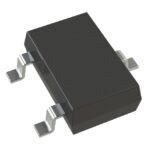 SST505 SOT-23 3L
The activity of extra discounts on wholesale prices is in full swing…
Please fill in your contact information and we will send you the latest wholesale price list.





