 ChipApex | Global Electronic Components Supplier
SEARCH
Search Product
Search Post
— IC芯片 | 连接器 | 传感器 | 被动器件 —
Search productSearch post
— IC芯片 | 连接器 | 传感器 | 被动器件 —
Consult the customer manager about the wholesale price.
consultation hotline:86-132-6715-2157
email:[email protected]
Contact the product manager for consultation. One-stop consultation is available.
Do you want a lower wholesale price? Please send us your inquiry and we will reply immediately.
The STK672-440AN-E is a thick-film hybrid IC designed as a unipolar, 2-phase stepper motor driver with PWM current control. It features built-in overcurrent and overheat detection functions that trigger an active-low fault signal. The device includes a power-on reset function and supports Schmitt inputs for 2.5V high-level logic. Motor current is adjustable via two external resistors using an internal 0.089Ω detection resistor. The enable pin allows output current cutoff while maintaining excitation mode.
Verify the manufacturer origin, as this component was originally developed by Sanyo Semicon Device before corporate acquisitions. Confirm the specific suffix 'E' denotes environmental compliance status according to official documentation. Ensure the SIP-22 package dimensions match your PCB footprint requirements. Check for any obsolescence notices or lifecycle status updates from the current rights holder.
Select this component for applications requiring precise 2-phase stepper motor control with integrated protection mechanisms. The built-in PWM current control offers efficient operation compared to fixed-current drivers. Consider the thermal dissipation capabilities if operating near maximum ratings. The microstep support and phase hold functions make it suitable for precision positioning tasks in office automation equipment.
This part belongs to the STK672 series of thick-film hybrid ICs, originally manufactured by Sanyo Semiconductor. The series includes various models tailored for different phase configurations and current requirements. The STK672-440AN-E specifically targets 2-phase unipolar stepper motors, offering a compact solution for integration into space-constrained office automation devices.
The STK672-732AN-E is documented as having compatible pins with the STK672-440AN-E. Verify electrical parameter alignment, particularly output current ratings and voltage specifications, before substitution. Other models in the STK672 family may require circuit modifications due to differing phase configurations or control interfaces.
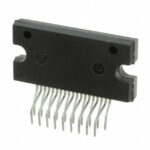 STK672-440AN-E
The activity of extra discounts on wholesale prices is in full swing…
Please fill in your contact information and we will send you the latest wholesale price list.





