 ChipApex | Global Electronic Components Supplier
SEARCH
Search Product
Search Post
— IC芯片 | 连接器 | 传感器 | 被动器件 —
Search productSearch post
— IC芯片 | 连接器 | 传感器 | 被动器件 —
Consult the customer manager about the wholesale price.
consultation hotline:86-132-6715-2157
email:[email protected]
Contact the product manager for consultation. One-stop consultation is available.
Do you want a lower wholesale price? Please send us your inquiry and we will reply immediately.
The STK672-740AN-E is a thick-film hybrid IC designed as a unipolar, 2-phase stepper motor driver with PWM current control. It features an operating substrate temperature range of -40°C to 105°C and a junction temperature limit of 150°C. The device supports a maximum supply voltage of 6.0V for both Vcc and Vdd, with a logic input voltage up to 6.0V. Output currents are rated at 4.0A (Iop), 10A (IoH), and 8.3A (IoF) under specific conditions. Allowable power dissipation reaches 3.1W without a heat sink. The package type is SIP-22.
Verify the exact ordering suffix against official manufacturer documentation to confirm pin compatibility and functional specifications. Ensure the component matches the required thermal management requirements given the power dissipation limits. Confirm availability status through authorized distributors as this series may have varying lifecycle stages. Cross-reference the datasheet revision date to ensure design compliance with current standards.
Select this component for applications requiring a unipolar 2-phase stepper motor driver with integrated protection. Consider the SIP-22 package dimensions and thermal characteristics for board layout. Verify that the external resistor values align with the internal current detection resistor tolerance for precise motor current setting. Ensure the control circuit provides active low phase signals compatible with the Schmitt input threshold.
This part belongs to the STK672 series of thick-film hybrid ICs manufactured by onsemi. These devices are specifically engineered for stepping motor drive applications, offering high reliability and compact integration. The series includes various models tailored for different phase configurations and current ratings, serving as robust solutions for motion control in office equipment.
The STK672-732AN-E is documented as having compatible pins with the STK672-740AN-E. When substituting, verify that the electrical parameters of the alternative model meet the system requirements. Ensure that any differences in current ratings or protection thresholds do not compromise the application's safety or performance.
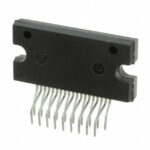 STK672-740AN-E
The activity of extra discounts on wholesale prices is in full swing…
Please fill in your contact information and we will send you the latest wholesale price list.





