ChipApex | Global Electronic Components Supplier

SEARCH
Search Product
Search Post
Search productSearch post
Consult the customer manager about the wholesale price.
consultation hotline:86-132-6715-2157
email:[email protected]
Contact the product manager for consultation. One-stop consultation is available.
Do you want a lower wholesale price? Please send us your inquiry and we will reply immediately.
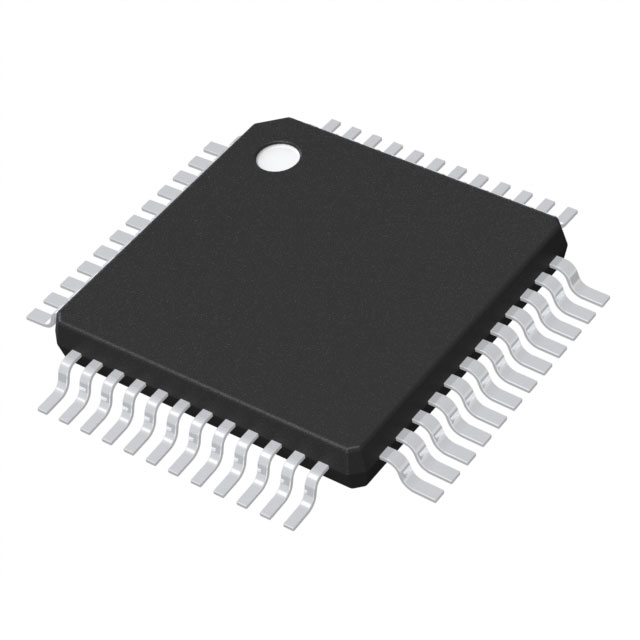
STM32F042C6T7 is listed in the Microcontrollers range at ChipApex. The manufacturer field lists STMicroelectronics. Its product description is IC MCU 32BIT 32KB FLASH 48LQFP. Review the specifications below when checking this part for your BOM.
The STM32F042C6T7 is an ARM-based 32-bit microcontroller from the STM32F042x6 series, manufactured by STMicroelectronics. It features an ARM Cortex-M0 CPU operating at up to 48 MHz, 32 Kbytes of Flash memory, and 6 Kbytes of SRAM with hardware parity. The device includes a crystal-less USB 2.0 Full-speed interface, CAN controller, HDMI CEC, one I2C, two SPIs/I2S, and two USARTs. It operates on a 2.0 V to 3.6 V supply within -40 °C to +85 °C or +105 °C ranges and utilizes a TSSOP20 package.
Verify the specific ordering suffix 'T7' against official STMicroelectronics documentation, as standard datasheets typically list 'T6' for TSSOP-20 packages. Confirm package type, temperature range, and production status directly with the manufacturer or authorized distributors to ensure compatibility with design requirements.
Select this MCU for cost-sensitive applications requiring integrated USB and CAN connectivity without external crystals. Consider the 32 KB Flash and 6 KB RAM limits for code size and data storage needs. Evaluate pin count availability in the TSSOP-20 package against I/O requirements before finalizing the component choice.
This component belongs to the STM32F042x4/x6 family, which are mainstream Arm Cortex-M0 USB line MCUs. The family provides a balance of performance and peripheral integration for entry-level embedded systems. The STM32F042C6 variant specifically offers 32 KB Flash memory and is available in multiple packages including TSSOP-20.
No, the device supports crystal-less USB Full-speed operation using its internal 48 MHz oscillator with automatic trimming based on external synchronization.
The ARM Cortex-M0 CPU operates at a frequency of up to 48 MHz.
Explore related parts through Embedded, Integrated Circuits (ICs), all product categories, ChipApex homepage.
STMicroelectronics STM32F042C6T7 is usually screened in Microcontrollers category when power sequencing, recovery behavior, and I/O planning need a released validation path instead of ad hoc bring-up fixes. Key specs include Description (IC MCU 32BIT 32KB FLASH 48LQFP), Core (ARM® Cortex®-M0), Speed (48MHz), Flash (32KB (32K x 8)), and RAM (6K x 8). On the assembled product, teams usually come back to i/o (38) before they treat the part as approved.
Who is the manufacturer of STM32F042C6T7?
STMicroelectronics
Any tips for migrating firmware to STM32F042C6T7?
Confirm pin functions, peripheral differences, timing assumptions, and memory layout, then validate under worst-case operating conditions.
Which supply voltage is specified for STM32F042C6T7?
1.65V ~ 3.6V
What is the program memory size of STM32F042C6T7?
32KB (32K x 8)
Selecting STMicroelectronics STM32F042C6T7 for Microcontrollers usually comes down to the constraints that still matter after build: fit, limits, recovery behavior, and testability on the real hardware. Once the part is on the shipped assembly, the first review usually comes back to core (ARM® Cortex®-M0), speed (48MHz), and flash (32KB (32K x 8)). They commonly sit at the center of sensor fusion, protocol processing, or deterministic control loops where latency and reliability matter. Well-matched compute devices reduce software complexity by providing the right hardware acceleration and I/O integration. Microcontrollers are usually released only after boot straps, reset timing, debug access, and power-domain behavior are checked on assembled hardware, because many field faults begin as recovery problems rather than obvious functional misses. Design teams generally benefit when failure modes are predictable and qualification evidence is easy to reproduce.
 STM32F042C6T7

The activity of extra discounts on wholesale prices is in full swing…
Please fill in your contact information and we will send you the latest wholesale price list.