 ChipApex | Global Electronic Components Supplier
SEARCH
Search Product
Search Post
— IC芯片 | 连接器 | 传感器 | 被动器件 —
Search productSearch post
— IC芯片 | 连接器 | 传感器 | 被动器件 —
Consult the customer manager about the wholesale price.
consultation hotline:86-132-6715-2157
email:[email protected]
Contact the product manager for consultation. One-stop consultation is available.
Do you want a lower wholesale price? Please send us your inquiry and we will reply immediately.
The STP08DP05TTR is a low-voltage, low-current power 8-bit shift register designed for LED panel displays. It features an 8-bit serial-in, parallel-out shift register feeding a D-type storage register. The output stage provides regulated constant current sources of 1 mA to drive LEDs. It supports a supply voltage range from 3 V to 3.6 V with a maximum supply current of 13.5 mA. The device operates within a temperature range of -40 °C to +125 °C and utilizes a TSSOP-16 package.
Verify the specific suffix 'TTR' against the manufacturer's official documentation to confirm the exact packaging configuration, such as cut tape or reel specifications. Ensure that the component meets the required RoHS compliance standards for your manufacturing process. Cross-reference the datasheet revision history to confirm active status and any potential design changes affecting electrical characteristics or pinout definitions prior to final procurement.
Select this component when designing LED displays requiring integrated fault detection capabilities alongside constant current sinking. It is suitable for systems needing adjustable brightness control and high reliability in automotive or industrial environments due to its extended temperature range. Consider the exposed pad package option if superior heat dissipation is critical for the application's thermal management strategy.
This part belongs to the STP08DP05 series of monolithic LED sink drivers. It extends the functionality of previous models like the STP8C/L596 by adding diagnostic features while maintaining backward compatibility in footprint and basic operation. The series is engineered for robust performance in low-voltage digital interfaces, providing a reliable solution for modern LED matrix architectures.
The STP08DP05XTTR serves as a verified alternative within the same product family, offering similar linear driver topology and 100mA channel current capacity in a 16-HTSSOP package. Verify functional equivalence regarding output current regulation and diagnostic features before substitution.
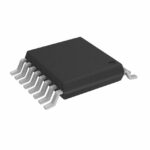 STP08DP05TTR
The activity of extra discounts on wholesale prices is in full swing…
Please fill in your contact information and we will send you the latest wholesale price list.





