 ChipApex | Global Electronic Components Supplier
SEARCH
Search Product
Search Post
— IC芯片 | 连接器 | 传感器 | 被动器件 —
Search productSearch post
— IC芯片 | 连接器 | 传感器 | 被动器件 —
Consult the customer manager about the wholesale price.
consultation hotline:86-132-6715-2157
email:[email protected]
Contact the product manager for consultation. One-stop consultation is available.
Do you want a lower wholesale price? Please send us your inquiry and we will reply immediately.
The STPA003OD-4WX is a Class-AB MOSFET quad bridge power amplifier designed for high-power car radio applications. It delivers up to 52 W per channel into 4 Ω loads and 85 W per channel into 2 Ω loads. The device operates within a supply voltage range of 6 V to 18 V, supporting low-voltage 'start-stop' battery profiles. Key electrical parameters include a maximum output power of 55 W at 2 Ω with 10% THD+N at 14.4 V, and a total harmonic distortion plus noise of 0.02%. It features internally fixed gain of 26 dB, no external compensation requirements, and operates across a temperature range from -40 °C to +105 °C.
Verify the specific suffix OD-4WX against official datasheets to confirm package type and pinout compatibility. Ensure the selected variant matches the required Flexiwatt-25 or Flexiwatt-27 package configuration. Confirm AEC-Q100 qualification status if automotive reliability standards are mandatory for the target application environment.
Select this component when designing for high-output power in constrained low-voltage automotive environments. The internal fixed gain eliminates external compensation components, reducing bill of materials. Consider the robust protection features for harsh automotive electrical conditions. Verify thermal management requirements given the high power density in the Flexiwatt package.
This part belongs to the STPA003 series of MOSFET class AB audio power amplifiers. The series is engineered specifically for automotive OEM specifications, emphasizing durability and performance under varying battery voltages. It represents a solution for integrating high-fidelity audio capabilities directly into modern vehicle infotainment systems without complex external circuitry.
STPA002OD-4WX offers similar quad bridge architecture but with different power ratings and THD characteristics. STPA008-4WX provides a comparable 4-channel solution with potentially different thermal and packaging attributes. Verify pin-to-pin compatibility and electrical parameter overlaps before substituting.
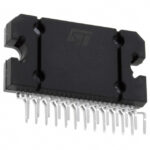 STPA003OD-4WX
The activity of extra discounts on wholesale prices is in full swing…
Please fill in your contact information and we will send you the latest wholesale price list.





